
Quick Answer
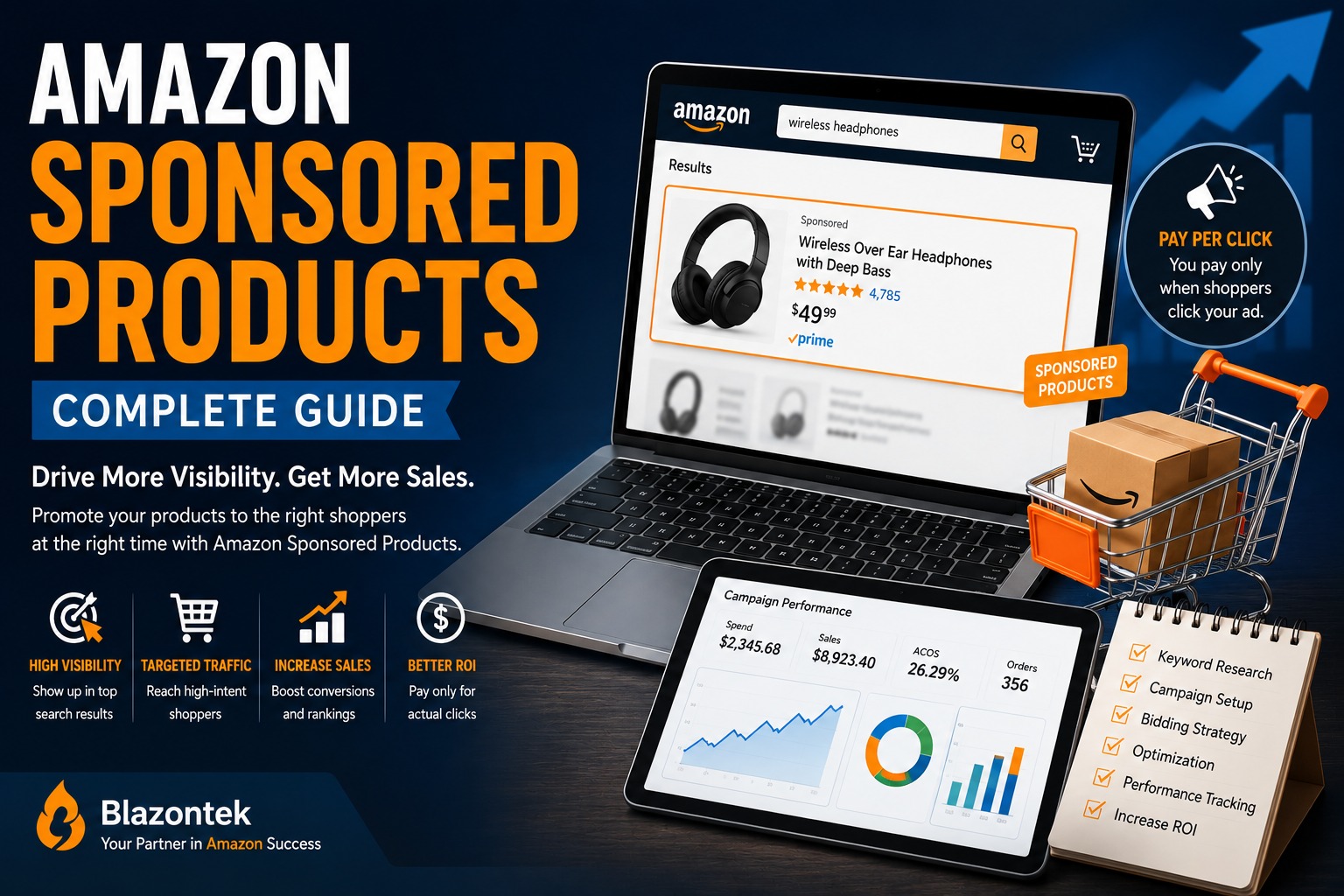
Amazon Sponsored Products are pay-per-click (PPC) ads that help sellers promote individual products in Amazon search results and on product detail pages. You pay when a shopper clicks the ad, not simply when it is displayed.
A successful amazon sponsored products strategy combines relevant keyword targeting, competitive bids, strong product listings, negative keywords, appropriate budgets, and continuous optimization. Sponsored Products can be particularly valuable for new product launches, increasing visibility for established products, defending branded searches, and capturing high-intent shoppers across marketplaces such as the US, UK, Canada, Australia, UAE, and Europe.
The important point is simple: PPC can bring shoppers to your listing, but your listing has to convince them to buy.
Introduction
Selling on Amazon can feel a little like opening a store in the busiest shopping district in the world.
Your product may be excellent. Your pricing may be competitive. Your packaging may look professional. But if shoppers don’t see your product when they search, those advantages don’t mean much.
This is where amazon sponsored products become important.
Sponsored Products give sellers a way to place their products in front of shoppers who are already searching for relevant products. Instead of waiting for organic visibility to build over time, brands can use advertising to create targeted visibility and gather valuable performance data.
But there is a common misconception.
Launching a campaign does not automatically mean more profitable sales.
An advertiser can spend hundreds or thousands of dollars and still struggle with poor conversion rates, expensive clicks, or irrelevant traffic.
The difference usually comes down to strategy.
This guide explains how amazon sponsored products work, how to structure campaigns, how bidding works, what metrics to monitor, and how overseas sellers and international brands can use Sponsored Products more effectively.
What Are Amazon Sponsored Products?
Sponsored Products Amazon advertising is designed to promote individual product listings to relevant shoppers.
These ads can appear in locations such as:
- Top of Amazon search results
- Other search result positions
- Product detail pages
- Related product sections
Sponsored Products generally operate on a cost-per-click model.
Simple Example
Suppose you sell a stainless steel water bottle.
A shopper searches:
stainless steel water bottle
Your product is eligible for the auction.
If your ad wins the placement and the shopper clicks it, you pay for that click.
Customer Search
↓
Keyword / Product Targeting
↓
Amazon Ad Auction
↓
Sponsored Product Appears
↓
Customer Clicks
↓
Product Listing
↓
Purchase
This is why advertising and listing optimization should never be treated as completely separate activities.
How Amazon Sponsored Products Work
The amazon sponsored products guide starts with understanding the advertising auction.
When you create a campaign, you provide Amazon with targeting and bidding instructions.
Depending on your campaign setup, Amazon determines when your product is eligible to appear based on factors such as:
- Targeting relevance
- Bid
- Product relevance
- Customer search
- Competition
- Expected performance
Winning an impression is only the first step.
The shopper still needs to click.
Then the product page needs to convert that visitor.
Sponsored Products Customer Journey
A useful way to understand PPC is through the following framework:
| Stage | Question |
| Impression | Did shoppers see the product? |
| Click | Did the ad attract attention? |
| Product View | Did the listing communicate value? |
| Add to Cart | Was the offer competitive? |
| Purchase | Did the customer convert? |
| Repeat Purchase | Can the product create long-term value? |
This means a low-sales campaign does not always have a “PPC problem.”
It could have a:
- Keyword problem
- Creative problem
- Listing problem
- Pricing problem
- Review problem
- Offer problem
A good advertiser investigates the entire journey.
Why Use Amazon Sponsored Products?
There are several reasons brands invest in Sponsored Products.
1. Immediate Visibility
Organic rankings can take time.
Advertising can put eligible products in front of shoppers much sooner.
2. High Purchase Intent
Amazon shoppers are often already looking for a product.
This makes the platform particularly valuable for performance-focused advertising.
3. Product Launch Support
New products have limited sales history.
Sponsored Products can help generate initial traffic and gather search-term data.
4. Competitor Targeting
Product targeting allows sellers to advertise against relevant product pages and competitor products where appropriate.
5. Keyword Discovery
PPC campaigns can reveal actual search behavior that can later inform listing and SEO strategies.
Types of Sponsored Products Campaigns
There are two broad approaches to targeting:
| Campaign Type | How It Works | Best For |
| Automatic Targeting | Amazon identifies relevant searches and products | Discovery |
| Manual Targeting | Seller selects keywords or products | Control and scaling |
Both have a role.
A common mistake is treating Auto and Manual campaigns as competitors.
They can work together.
Automatic Campaigns
Automatic targeting is useful when you want Amazon to identify relevant opportunities based on your product information.
It can help discover:
- Unexpected search terms
- Long-tail queries
- Related products
- Customer shopping patterns
For new products, Auto campaigns can provide valuable data.
However, simply leaving an Auto campaign running indefinitely isn’t an effective optimization strategy.
Manual Campaigns
Manual targeting provides greater control over where your advertising budget goes.
Common keyword match types include:
- Broad
- Phrase
- Exact
Typical Funnel
AUTO
Discovery
↓
BROAD
Keyword Expansion
↓
PHRASE
Intent Refinement
↓
EXACT
Profit & Scale
This is a useful framework, but campaigns should always be adapted based on actual performance data.
Amazon Sponsored Products Strategy
A strong amazon sponsored products strategy should start before the campaign is created.
Step 1: Understand Your Product
Identify:
- Main product category
- Core benefits
- Customer problems
- Differentiators
- Price positioning
- Primary competitors
Step 2: Research Keywords
Don’t only chase the keywords with the highest search volume.
Look for a balance between:
Search volume + relevance + buying intent + competition
For example:
Instead of targeting only:
running shoes
you might also consider:
men’s trail running shoes
lightweight trail running shoes
waterproof running shoes for hiking
Long-tail searches may have lower volume but stronger purchase intent.
Campaign Structure Framework
A clean account is easier to manage.
A basic structure could look like this:
PRODUCT A
│
├── Auto Campaign
│
├── Broad Campaign
│
├── Phrase Campaign
│
├── Exact Campaign
│
└── Product Targeting
For larger catalogs, separate campaigns by:
- Product
- Product category
- Brand
- Market
- Objective
Avoid creating hundreds of campaigns without a clear reason.
Complexity isn’t the same as sophistication.
Amazon Sponsored Products Bidding
Amazon sponsored products bidding is one of the most important parts of campaign management.
Your bid tells Amazon how much you are willing to pay for a click.
But the highest possible bid isn’t necessarily the best strategy.
Consider this example:
| Keyword | CPC | Sales | Result |
| Keyword A | $1.80 | 8 | Strong |
| Keyword B | $2.50 | 2 | Weak |
| Keyword C | $0.90 | 10 | Excellent |
Keyword C may deserve more budget despite having the lowest CPC.
The goal is not:
Get the cheapest clicks.
The goal is:
Get profitable clicks.
Bid Optimization Framework
Use performance data to guide adjustments.
High Conversion + Profitable
↓
Consider Scaling
Good Conversion + High CPC
↓
Review Bid
Many Clicks + No Sales
↓
Reduce / Investigate
Irrelevant Traffic
↓
Add Negative
Don’t make large bid changes simply because performance changed for one day.
Look for meaningful patterns.
Understanding Amazon Sponsored Products Optimization
Amazon sponsored products optimization is an ongoing process rather than a one-time setup.
Your optimization routine should include:
Weekly
- Search-term analysis
- Negative keyword updates
- Bid reviews
- Budget checks
- New keyword discovery
Monthly
- Campaign restructuring
- Product-level performance analysis
- Placement analysis
- ACOS and ROAS evaluation
- Budget reallocation
The Most Important PPC Metrics
| Metric | What It Tells You |
| Impressions | Visibility |
| CTR | Ad relevance and appeal |
| CPC | Cost of traffic |
| Orders | Sales generated |
| Conversion Rate | Listing effectiveness |
| ACOS | Advertising efficiency |
| ROAS | Revenue generated per advertising dollar |
| TACOS | Advertising spend relative to total sales |
Never evaluate a campaign using ACOS alone.
For example, a campaign with a 30% ACOS may be highly profitable for one product and unprofitable for another depending on margins.
Amazon Sponsored Products Ads and Listing Quality
One of the biggest mistakes sellers make is sending paid traffic to an unprepared listing.
Before increasing your advertising budget, review:
Product Title
Is it clear and relevant?
Main Image
Does it communicate the product immediately?
Bullet Points
Do they explain benefits rather than simply listing specifications?
Product Images
Do they answer common customer questions?
A+ Content
Does it strengthen the brand story and address purchase objections?
Reviews
Does the product have enough social proof?
Pricing
Is the offer competitive?
Advertising amplifies whatever is already happening on your product page.
If the listing converts poorly, more traffic can simply mean more wasted spend.
Amazon Sponsored Products Optimization Checklist
Use this checklist before scaling a campaign.
Campaign Setup
☐ Campaign objective defined
☐ Correct products selected
☐ Auto and Manual campaigns structured
☐ Appropriate daily budgets established
☐ Naming conventions standardized
Keyword Targeting
☐ Relevant keywords researched
☐ High-intent keywords identified
☐ Broad, Phrase, and Exact targeting tested
☐ Search terms reviewed
☐ Negative keywords added
Bidding
☐ Initial bids are competitive
☐ High-performing keywords identified
☐ Poor-performing bids reduced
☐ Placement performance reviewed
☐ Budget concentrated on profitable opportunities
Listing
☐ Title optimized
☐ Images optimized
☐ Bullet points improved
☐ A+ Content considered
☐ Pricing competitive
☐ Reviews monitored
Performance
☐ CTR monitored
☐ Conversion rate monitored
☐ ACOS reviewed
☐ ROAS reviewed
☐ TACOS tracked
☐ Search-term data analyzed
Common Sponsored Products Mistakes
1. Setting and Forgetting Campaigns
Amazon PPC requires ongoing management.
A campaign that worked last quarter may not work today.
2. Using Only Broad Keywords
Broad targeting can help discovery, but relying on it exclusively can create unnecessary traffic.
3. Ignoring Negative Keywords
Irrelevant clicks consume budget.
Negative targeting helps protect spend.
4. Increasing Bids Without Looking at Conversion
A higher bid can increase traffic.
It doesn’t guarantee profitable sales.
5. Sending Traffic to Weak Listings
PPC cannot compensate indefinitely for poor product pages.
6. Measuring Only ACOS
A campaign should be evaluated in the context of:
- Product margins
- Organic sales
- Total revenue
- Customer acquisition
- Business objectives
Sponsored Products for International Sellers
For overseas brands, Amazon advertising becomes more complex because each marketplace behaves differently.
A strategy that works in the US may need significant adjustments in the UK, Germany, Canada, UAE, or Australia.
Consider:
| Factor | Why It Matters |
| Local Search Terms | Customers use different language |
| Currency | Affects profitability |
| Competition | CPC varies by marketplace |
| Pricing | Local purchasing power differs |
| Seasonality | Shopping periods vary |
| Regulations | Product claims may require attention |
International sellers should avoid simply copying the same campaign from one marketplace to another.
Localize the strategy, not just the listing.
Amazon Sponsored Products Launch Strategy
For a new product, consider a three-stage approach.
Phase 1: Discovery
Use Auto and exploratory Manual campaigns.
Goal: Collect data.
Phase 2: Optimization
Identify:
- Converting search terms
- Profitable keywords
- Negative keywords
- Strong placements
Goal: Improve efficiency.
Phase 3: Scaling
Increase investment in proven keywords and campaigns.
Goal: Grow profitable sales.
DISCOVER
↓
ANALYZE
↓
OPTIMIZE
↓
SCALE
↓
REPEAT
This cycle should continue throughout the product lifecycle.
How to Know If Your Campaign Needs Optimization
Watch for these warning signs:
- ACOS is increasing
- CPC keeps rising
- Clicks increase but orders don’t
- Campaigns frequently run out of budget
- Too much spend comes from irrelevant searches
- Organic rankings aren’t improving despite strong sales
- One or two keywords consume most of the budget
- Conversion rate is falling
These signals don’t automatically mean the campaign is failing.
They mean it deserves investigation.
Amazon Sponsored Products Tutorial: A Simple Workflow
If you’re setting up Sponsored Products for the first time, follow this process:
1. Select your product
Choose products with competitive pricing and strong listings.
2. Define your objective
Decide whether you’re launching, growing, defending, or maximizing profitability.
3. Research keywords
Build a list based on relevance and purchase intent.
4. Create Auto and Manual campaigns
Use Auto for discovery and Manual campaigns for greater control.
5. Set realistic budgets
Start with an amount you can analyze properly.
6. Monitor performance
Allow enough data to accumulate before making major changes.
7. Optimize
Adjust bids, budgets, keywords, and targeting.
8. Scale
Move more budget toward proven opportunities.
Key Takeaways
- amazon sponsored products are a powerful way to generate targeted visibility on Amazon.
- sponsored products amazon campaigns work on a pay-per-click model, meaning sellers generally pay when shoppers click their ads.
- A strong amazon sponsored products guide should cover targeting, bidding, budgets, listings, and optimization.
- amazon sponsored products ads work best when paired with conversion-focused product pages.
- A structured amazon sponsored products campaign makes performance easier to analyze and scale.
- amazon sponsored products optimization is an ongoing process based on real customer and campaign data.
- Understanding how amazon sponsored products work helps sellers make better decisions about advertising spend.
- A clear amazon sponsored products strategy balances visibility, sales, profitability, and long-term growth.
- amazon sponsored products bidding should be based on conversion and profitability rather than simply trying to win every auction.
- This amazon sponsored products tutorial provides a practical framework for launching, analyzing, optimizing, and scaling campaigns.
Frequently Asked Questions
What are Amazon Sponsored Products?
Amazon Sponsored Products are PPC advertisements that promote individual products across eligible Amazon placements. Sellers pay when shoppers click their ads.
Are Amazon Sponsored Products worth it?
They can be highly valuable when campaigns are properly targeted and the underlying product listing is competitive. They are particularly useful for product launches, increasing visibility, and capturing high-intent searches.
How much should I spend on Sponsored Products?
There is no universal budget. Your starting budget should depend on product margins, competition, sales goals, and marketplace. A smaller seller can begin with a controlled daily budget and increase investment as profitable opportunities become clear.
Should I use Auto or Manual campaigns?
Both can be useful. Auto campaigns are valuable for discovery, while Manual campaigns provide greater control over keyword and product targeting.
How often should I optimize Sponsored Products campaigns?
Review performance regularly, particularly search terms, bids, budgets, and conversions. Larger accounts may require weekly or even more frequent monitoring.
Can Sponsored Products improve organic rankings?
Advertising can contribute to sales and keyword visibility, which may support broader organic growth. However, PPC does not guarantee a particular organic ranking. Organic performance depends on multiple factors, including relevance, sales performance, conversion, and customer experience.
What is the biggest Sponsored Products mistake?
One of the most common mistakes is increasing advertising spend without first checking whether the product listing can convert the additional traffic.
Conclusion
Amazon Sponsored Products can be one of the most effective growth tools available to sellers, but successful advertising is about much more than choosing a few keywords and setting a bid.
The strongest campaigns connect targeting, bidding, listing quality, customer intent, and profitability.
For a new product, Sponsored Products can provide the visibility and data needed to understand the market. For an established product, they can help defend valuable keywords, capture additional demand, and scale profitable sales.
For international brands, the opportunity is even broader. Amazon marketplaces across the US, UK, Canada, Europe, Australia, and the Middle East offer access to millions of potential customers, but each market requires thoughtful localization and performance analysis.
The best approach is therefore simple:
Launch with a strategy. Analyze the data. Optimize continuously. Scale what works.
If your Amazon campaigns are generating clicks but not enough sales, or if your advertising costs are increasing without proportional growth, a professional PPC review can help identify where the opportunity is being lost.
At Blazontek, Amazon brands build, manage, and optimize advertising campaigns with a focus on visibility, conversions, and profitable growth. Whether you’re launching a new product or scaling across international marketplaces, the right amazon marketing services can turn advertising spend into a more predictable growth engine.