
Quick Answer
Launching a product with zero reviews does not mean you should avoid Amazon advertising. It means your PPC strategy needs to be more controlled.
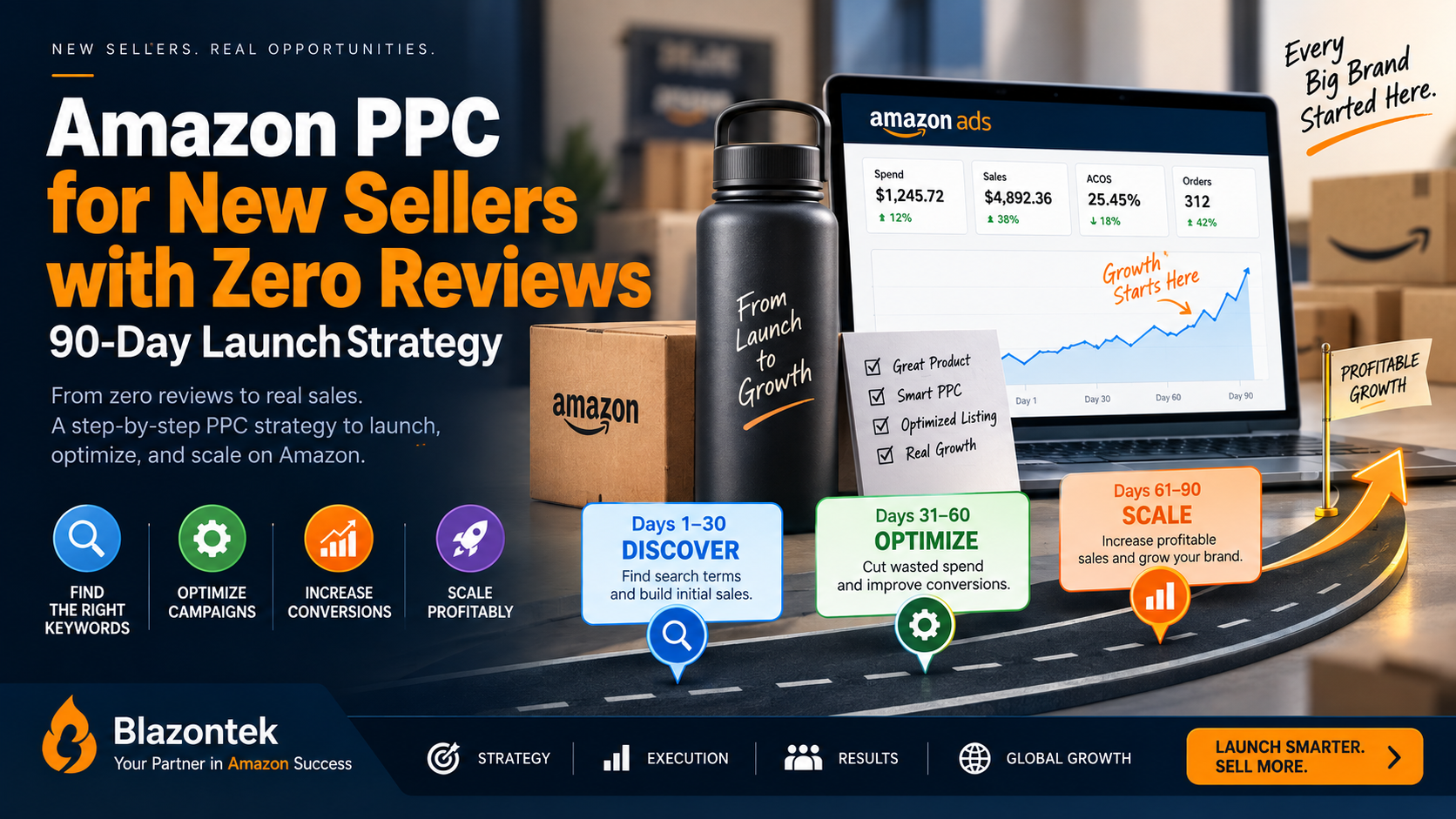
A strong amazon ppc new product launch strategy uses the first 90 days in three stages: Days 1–30 for discovery, Days 31–60 for optimization, and Days 61–90 for profitable scaling. New sellers should begin with a retail-ready listing, use automatic and tightly targeted manual campaigns to collect search-term data, gradually move converting queries into more controlled campaigns, and optimize bids based on conversion and profitability.
The goal during the first few weeks is not necessarily to achieve your lowest possible ACOS. It is to learn which shoppers click, which search terms convert, and which parts of your listing need improvement.
Key Takeaways
- Amazon ppc for new sellers should prioritize learning before aggressive scaling.
- Zero reviews make conversion harder, so listing quality, pricing, images, and offer positioning become especially important.
- Start with controlled Auto, Broad/Phrase, Exact, and relevant product-targeting campaigns rather than advertising everywhere.
- Days 1–30 should generate useful data, Days 31–60 should eliminate waste, and Days 61–90 should concentrate investment on proven opportunities.
- Do not judge PPC using ACOS alone during a launch. Monitor CTR, conversion rate, CPC, orders, organic movement, TACOS, and profitability.
- PPC and listing optimization should work together. Advertising cannot permanently compensate for a product page that fails to build confidence.
- Zero reviews are a disadvantage, but they are not a reason to manufacture reviews or use non-compliant tactics.
The Zero-Review Problem Most New Amazon Sellers Face
You have researched the market, sourced the product, prepared the packaging, created the listing, and sent inventory to Amazon.
Then the product goes live.
There is just one problem:
0 reviews.
Meanwhile, the products around yours may have hundreds or thousands.
This is one of the most difficult stages of an Amazon launch. You need sales to establish performance, but customers often use reviews as one of several signals when deciding whether an unfamiliar product deserves their money.
This creates a temptation to solve the problem by simply spending more on PPC.
That can become expensive very quickly.
The better approach is to treat your first 90 days as a structured learning and growth period.
Your advertising should help you answer three questions:
- Which searches generate qualified traffic?
- Which searches actually produce orders?
- What prevents interested shoppers from converting?
That is the foundation of an effective amazon ppc for zero reviews products strategy.
Why PPC Is Different When You Have Zero Reviews
Consider two similar products.
| Factor | New Product | Established Competitor |
| Reviews | 0 | 1,500+ |
| Sales history | Limited | Established |
| Brand recognition | Low | Strong |
| PPC data | Limited | Extensive |
| Conversion history | Unknown | Proven |
| Customer confidence | Developing | Established |
If both products receive the same 100 clicks, the established product may have an immediate conversion advantage.
That means a new seller should not blindly copy the competitor’s bids.
Your PPC has to compensate through better relevance, stronger presentation, competitive positioning, and careful targeting.
Your first objective is not to win every auction. It is to find the auctions worth winning.
Before Day 1: Make Your Listing PPC-Ready
Do not switch on advertising simply because the ASIN has become active.
Before launch, perform a basic retail-readiness check.
Your product should have:
- A clear, keyword-relevant title
- A professional main image
- Strong secondary images
- Benefit-focused bullet points
- Accurate product information
- Competitive pricing
- Appropriate inventory
- Clear differentiation
- A+ Content where eligible and appropriate
- A mobile-friendly product page
This is where your Amazon Listing Optimization article should be internally linked.
Suggested anchor: Amazon Product Listing Optimization
A click is only valuable when the page receiving that traffic has a realistic chance of converting it.
The 90-Day Amazon PPC Launch Framework
A practical launch can be divided into three phases:
DAYS 1–30
DISCOVER
Find search terms and establish baseline performance
↓
DAYS 31–60
OPTIMIZE
Cut waste and strengthen converting targets
↓
DAYS 61–90
SCALE
Increase investment behind proven opportunities
Each stage has a different purpose.
Trying to optimize Day 5 like Day 85 can lead to premature decisions.
Phase 1: Days 1–30 – Discovery
Objective: Learn What Customers Actually Search For
During your first month, you have limited advertising history.
You may have completed extensive keyword research, but research is still a hypothesis until real shoppers interact with your ads.
Your initial campaign structure should therefore balance discovery with control.
Starter Campaign Structure
| Campaign | Purpose |
| Automatic | Search-term discovery |
| Manual Broad | Keyword expansion |
| Manual Phrase | More controlled discovery |
| Manual Exact | Priority high-intent terms |
| Product Targeting | Relevant ASIN/category opportunities |
You do not need dozens of campaigns on launch day.
A simple structure that produces interpretable data is more useful than an unnecessarily complex account.
Step 1: Start with Automatic Targeting
Automatic campaigns can help Amazon identify searches and shopping contexts relevant to your product.
They are especially useful when you do not yet have significant conversion data.
But an Auto campaign should be a research tool, not a dumping ground for your advertising budget.
Monitor the actual search terms it generates.
Look for:
- Relevant searches
- Unexpected long-tail searches
- Converting queries
- Irrelevant traffic
- Product-targeting opportunities
Over time, valuable discoveries can inform your Manual campaigns.
Step 2: Launch Manual Keyword Campaigns
Your initial Manual campaigns should include keywords with strong relevance and realistic buying intent.
Suppose you sell a stainless steel insulated water bottle.
A broad keyword might be:
water bottle
A more specific keyword could be:
stainless steel insulated water bottle
An even more purchase-focused query could be:
32 oz stainless steel insulated water bottle
The more specific query may receive fewer searches, but the shopper’s intent is clearer.
For zero-review products, relevance matters enormously because you cannot afford to pay repeatedly for curiosity clicks.
Step 3: Be Careful With Generic High-Volume Keywords
New sellers often want to rank immediately for the largest keywords in their category.
That ambition can become expensive.
High-volume terms often have:
- Higher CPC
- More established competitors
- Broader intent
- Greater conversion pressure
Do not ignore them completely if they are highly relevant.
But do not let one expensive generic keyword consume the entire launch budget.
Step 4: Establish Your Baseline Metrics
During Days 1–30, record your starting performance.
Monitor:
| Metric | What It Helps Diagnose |
| Impressions | Visibility |
| CTR | Relevance and ad/listing appeal |
| CPC | Cost of traffic |
| Conversion Rate | Product-page effectiveness |
| Orders | Actual demand |
| ACOS | Ad efficiency |
| ROAS | Revenue relative to ad spend |
| TACOS | Advertising’s relationship with total sales |
Do not panic because ACOS is initially higher than your mature-product target.
A launch campaign is also purchasing information.
But that does not mean losses should be ignored.
Zero Reviews: How Do You Improve Conversion?
You cannot ethically manufacture customer trust.
You can, however, remove uncertainty.
Your product page needs to answer questions such as:
- What exactly am I buying?
- Why is this product different?
- Does it solve my problem?
- What size is it?
- How does it work?
- What comes in the package?
- Is the price reasonable?
- Can I trust the information presented?
High-quality imagery becomes particularly important.
Instead of telling shoppers your product is “premium,” demonstrate why.
Show:
- Materials
- Dimensions
- Features
- Use cases
- Product details
- Packaging
- Relevant comparisons
The less uncertainty the customer feels, the less heavily your product has to rely on established brand familiarity alone.
Phase 2: Days 31–60 – Optimization
By Day 30, you should have more meaningful search-term and campaign data.
Now the objective changes.
Stop treating every target equally.
Step 5: Harvest Converting Search Terms
Suppose your Auto campaign discovers:
insulated bottle for hiking
It receives 17 clicks and generates four orders.
That is valuable information.
You can consider moving or adding that search term into a controlled Manual campaign so you can manage its bid and performance more deliberately.
The process looks like this:
DISCOVERY CAMPAIGN
↓
Search-Term Data
↓
Converting Query
↓
Manual Targeting
↓
Bid Optimization
↓
Potential Scaling
This process turns PPC data into an increasingly focused campaign structure.
Step 6: Start Cutting Wasted Spend
Now examine search terms receiving meaningful spend without generating results.
Ask why.
Is the query irrelevant?
Is the CPC too expensive?
Is the product mismatched with the shopper’s intent?
Or is the search relevant but the listing failing to convert?
These require different responses.
Example
| Search Term | Clicks | Orders | Likely Action |
| highly relevant term | 20 | 5 | Consider scaling |
| relevant term | 8 | 1 | Gather/analyze more data |
| irrelevant term | 10 | 0 | Consider negative |
| expensive generic term | 30 | 1 | Review bid and economics |
Avoid creating arbitrary universal rules such as “pause after exactly X clicks.”
Your selling price, margin, expected conversion rate, and CPC determine how much data is economically reasonable.
Step 7: Build a Negative Keyword Strategy
Negative keywords help prevent repeat spending on irrelevant searches.
Suppose you sell a premium full-size coffee machine but repeatedly receive traffic from:
- toy coffee machine
- coffee machine replacement parts
- used coffee machine
- coffee machine repair
These queries may not represent your target customer.
Negative targeting can improve efficiency.
However, be careful.
Overusing negatives can restrict discovery and accidentally block valuable traffic.
Step 8: Optimize Bids Based on Economics
Your bid should not be based on emotion or competitor visibility.
Use performance.
A simple decision framework is:
| Performance | Response |
| Profitable + converting | Consider increasing exposure |
| Converting + expensive | Optimize cautiously |
| Relevant + insufficient data | Continue testing |
| High spend + weak sales | Reduce bid/investigate |
| Irrelevant | Negative or stop targeting |
This is also an ideal location to internally link your How to Reduce ACOS article.
Suggested anchor: How to Reduce Amazon ACOS
Phase 3: Days 61–90 – Scale What Has Earned It
By the third month, your campaigns should contain substantially more useful information.
You should know:
- Which keywords convert
- Which search terms waste money
- Which match types perform well
- Which products attract conversions
- Which placements are effective
- How your listing converts
- Which campaigns deserve more budget
Now you can start scaling with greater confidence.
Step 9: Increase Budget on Proven Campaigns
Scaling does not mean doubling every budget overnight.
Prioritize campaigns that demonstrate:
Relevance + Conversion + Acceptable Economics + Available Demand
A campaign that consistently reaches its daily budget while generating profitable sales may deserve additional investment.
A campaign that barely converts does not deserve more money simply because you want more revenue.
Step 10: Expand Successful Keywords
If Exact Match keywords are producing consistent sales, explore closely related variations.
For example:
CORE WINNER
“insulated water bottle”
↓
“insulated water bottle 32 oz”
↓
“stainless insulated water bottle”
↓
“insulated bottle for hiking”
The goal is controlled expansion.
Not keyword volume for its own sake.
Step 11: Review Placement Performance
By Days 61–90, you may have enough data to evaluate how placements contribute to performance.
Compare:
- Top of Search
- Rest of Search
- Product Pages
If Top of Search generates substantially stronger conversion for a profitable keyword, increasing placement exposure may be worth testing.
But do not assume Top of Search is automatically best for every product.
Let the account data decide.
Step 12: Monitor Organic Movement Alongside PPC
One reason brands advertise during product launches is to generate sales and visibility while organic performance develops.
Track important search terms across both paid and organic performance.
Your objective over time is not necessarily:
PPC replaces organic sales.
It is:
PPC and organic visibility work together to grow total profitable sales.
This is why TACOS can provide useful context alongside ACOS.
90-Day Amazon PPC Launch Plan
| Period | Main Objective | Priority Actions |
| Days 1–15 | Establish data | Auto + controlled Manual campaigns |
| Days 16–30 | Identify patterns | Search-term analysis and listing review |
| Days 31–45 | Reduce waste | Negatives and bid adjustments |
| Days 46–60 | Strengthen winners | Harvest converting terms |
| Days 61–75 | Scale carefully | Increase investment in proven targets |
| Days 76–90 | Refine | Review profitability and organic growth |
How Much Should a New Seller Spend?
There is no universal launch budget.
A $20 product with a $6 contribution margin cannot use the same PPC economics as a $150 product with a $60 contribution margin.
Your budget should consider:
- Selling price
- Gross margin
- Break-even ACOS
- Expected CPC
- Expected conversion rate
- Category competition
- Number of products
- Launch objective
- Available cash flow
Think in Clicks, Not Just Daily Dollars
Suppose your average CPC is $1.50.
A $15 daily budget buys approximately 10 clicks.
If your product needs 15 clicks on average to generate an order, that budget may provide limited learning.
This is why copying someone else’s “$20/day launch strategy” can be misleading.
Build the budget around your economics and the amount of data required to make useful decisions.
What Is a Good ACOS for a New Product?
There is no universal “good ACOS.”
Start by understanding break-even ACOS.
If your pre-advertising margin is approximately 30%, then an ACOS materially above that level may mean advertising-attributed sales are not immediately profitable, depending on your full cost structure.
During launch, some sellers intentionally tolerate a higher ACOS to generate data and visibility.
That can be a strategic decision.
But it should be intentional, measured, and time-bound.
For a deeper explanation, internally link to your How to Reduce Amazon ACOS guide.
The New Seller PPC + Listing Framework
New products should not separate PPC from conversion optimization.
KEYWORD RELEVANCE
+
STRONG PRODUCT LISTING
+
COMPETITIVE OFFER
+
SMART PPC TARGETING
+
CONTINUOUS OPTIMIZATION
=
BETTER CHANCE OF PROFITABLE GROWTH
If advertising generates impressions but few clicks, investigate relevance and presentation.
If advertising generates clicks but few orders, investigate search intent and your product page.
If advertising generates orders but poor profitability, investigate CPC, bids, targeting, margins, and pricing.
Each symptom points toward a different problem.
5 Mistakes New Sellers Should Avoid
1. Spending Aggressively Before Optimizing the Listing
Traffic cannot fix a confusing product page.
2. Chasing Only High-Volume Keywords
Volume without intent can become expensive.
3. Judging Campaigns After a Few Clicks
Small samples can produce misleading conclusions.
4. Ignoring Search-Term Reports
Some of your best keyword opportunities may emerge from actual shopper searches.
5. Trying to Solve Zero Reviews Through Non-Compliant Shortcuts
Do not build a launch strategy around manipulated reviews. Focus instead on product quality, accurate content, strong customer experience, and Amazon-approved programs where eligible.
Amazon Sponsored Ads Beginner Checklist
This amazon sponsored ads beginner guide can be used before and during your first 90 days.
Before Launch
- Listing fully optimized
- Keyword research completed
- Competitive pricing reviewed
- Inventory available
- Product images checked
- Margins and break-even ACOS calculated
Days 1–30
- Automatic campaign running
- Manual targeting launched
- Search terms monitored
- CTR reviewed
- Conversion monitored
- Listing issues documented
Days 31–60
- Converting terms harvested
- Negative keywords added
- Bids optimized
- Wasted spend reduced
- Listing improved using real customer/search data
Days 61–90
- Winning campaigns scaled
- Placement performance reviewed
- Profitable keyword coverage expanded
- ACOS and TACOS analyzed
- Organic visibility reviewed
- Next 90-day growth plan prepared
Amazon New Seller Advertising Tips for Overseas Brands
International brands entering Amazon US, UK, Canada, Australia, UAE, or European marketplaces should avoid simply copying campaigns from their home market.
Your amazon new seller advertising tips should include localization.
Review:
- Local search terminology
- Spelling differences
- Currency and margins
- Local competition
- Seasonal demand
- Fulfilment expectations
- Product compliance
- Local pricing
- Customer preferences
For example, the way customers describe the same product in the US and UK can differ significantly.
Keyword localization is therefore more than translation.
It requires understanding how local customers actually search and buy.
When Should You Consider Professional Amazon PPC Management?
Managing one product with a small budget can be relatively straightforward.
Managing dozens or hundreds of keywords across multiple ASINs and international marketplaces becomes significantly more complicated.
Professional support may make sense when:
- ACOS keeps increasing
- PPC consumes too much internal time
- Campaign structure has become difficult to manage
- You are expanding internationally
- Search-term data is not being used effectively
- Sales are increasing but profitability is not
- You need PPC, SEO, listings, and creative strategy to work together
This is a natural place to link to Blazontek’s Amazon Marketing Services pillar page.
Rather than positioning PPC management simply as “running ads,” emphasize that successful Amazon growth requires coordination between advertising, listings, keywords, creative assets, and profitability.
Frequently Asked Questions
Should I run Amazon PPC with zero reviews?
Yes, you can advertise a new product with zero reviews. However, expect customer confidence and conversion behavior to differ from established products. Start with highly relevant targeting, a strong product page, competitive positioning, and controlled budgets.
How long should I run PPC before optimizing?
Monitor campaigns from the beginning, but avoid making major decisions from very small amounts of data. The appropriate amount of data depends on CPC, conversion expectations, margins, and search volume.
Should new sellers start with Auto campaigns?
Automatic campaigns can be valuable for discovering search terms, but they should generally form part of a broader strategy rather than being your only campaign type.
How much should I spend during the first 30 days?
There is no fixed amount. Calculate a budget using your average CPC, expected conversion rate, product margin, category competition, and the amount of traffic required to generate useful data.
Why am I getting clicks but no orders?
Potential reasons include irrelevant targeting, weak product images, insufficient differentiation, uncompetitive pricing, low customer confidence, poor listing content, or a mismatch between the keyword and product.
Should I lower my bids when ACOS is high?
Sometimes, but not automatically. First determine why ACOS is high. The issue could be CPC, conversion rate, search-term relevance, listing quality, or product economics.
Can Amazon PPC help a new product rank organically?
PPC can generate visibility and sales on relevant searches, which may support the broader performance signals associated with organic visibility. However, advertising does not guarantee a particular organic ranking.
When should I scale a new campaign?
Scale when you have enough evidence that a campaign or target generates relevant traffic, converts consistently, and fits your profitability or strategic launch objectives.
Key Takeaways
A successful amazon ppc new product launch strategy is not about spending aggressively from Day 1. It is about progressively replacing assumptions with real customer data.
For amazon ppc for new sellers, the first month should emphasize discovery, the second should emphasize efficiency, and the third should emphasize controlled scaling.
An amazon sponsored ads beginner guide should always connect advertising with listing quality because clicks alone do not create sales.
Running amazon ppc for zero reviews products requires extra attention to customer confidence, relevance, imagery, pricing, and differentiation.
And among the most important amazon new seller advertising tips is this: don’t judge your launch solely by how much revenue PPC generates. Judge whether the first 90 days are creating a stronger, more efficient, and more scalable Amazon business.
Conclusion: Your First 90 Days Should Build an Engine, Not Just Generate Orders
A new Amazon seller with zero reviews starts with a disadvantage, but not an impossible one.
You do not need thousands of reviews before advertising.
You need a disciplined launch process.
During Days 1–30, discover.
During Days 31–60, optimize.
During Days 61–90, scale what has proven itself.
Throughout all three phases, remember that PPC is only one part of the equation. Your keywords determine who arrives, your listing determines what they understand, your offer influences whether they buy, and your campaign management determines whether those sales can become profitable.
That is why successful Amazon launches should connect three areas:
Amazon Marketing + Listing Optimization + PPC Profitability
For brands entering competitive overseas marketplaces, this integrated approach becomes even more important. Rather than spending heavily and hoping Amazon finds the right customers, build a system that continuously learns from real search and conversion data.
At Blazontek, our Amazon Marketing Services help brands connect advertising with listing optimization, keyword strategy, campaign management, and marketplace growth. The objective is not simply to generate more clicks. It is to build an Amazon presence capable of turning the right clicks into sustainable sales.