
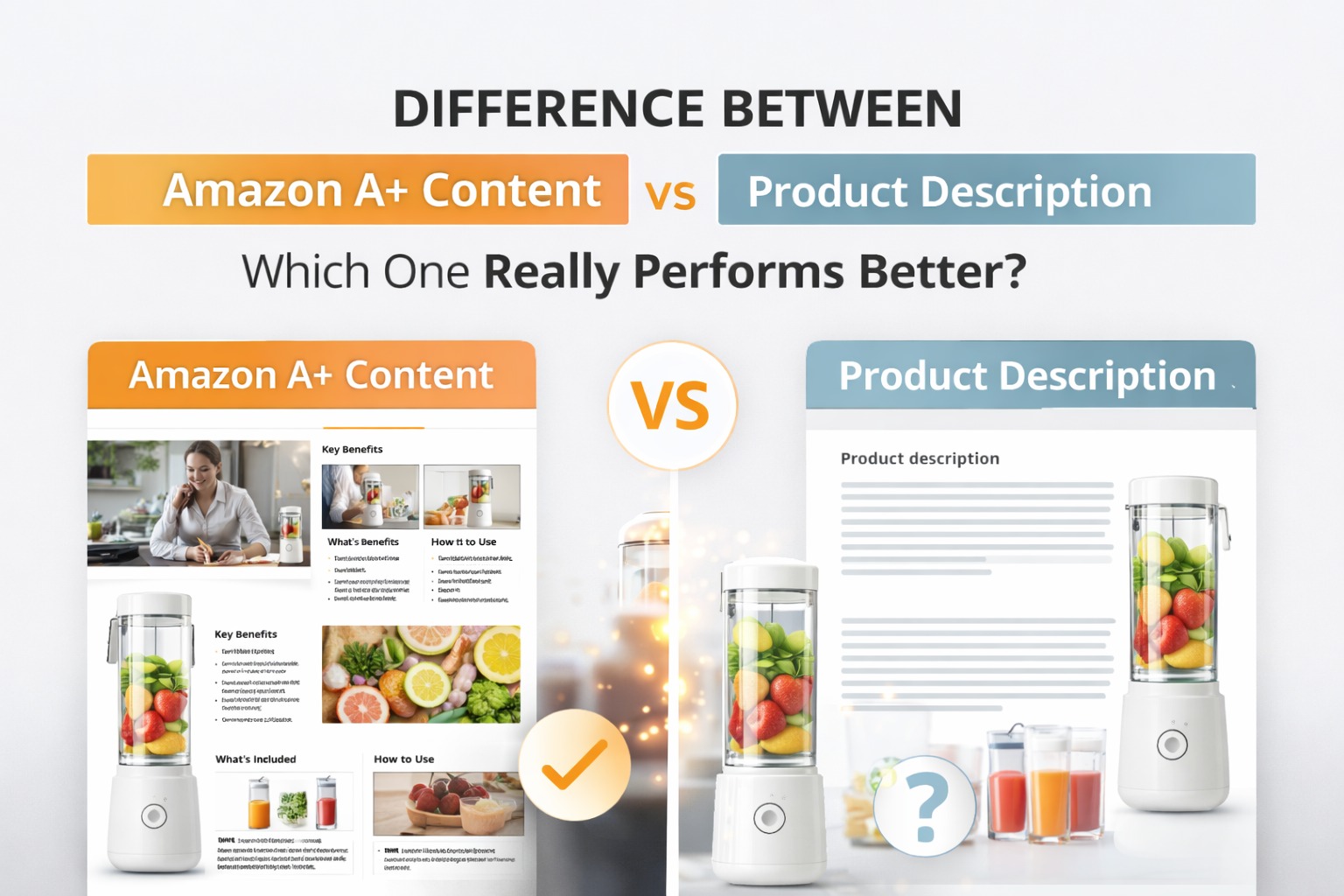
Key Takeaways
- The difference between Amazon A+ content and product description lies in purpose, not placement
- Product description supports visibility; A+ Content drives decisions
- Amazon product description vs A+ content is not an either/or choice
- A+ Content improves conversions; description supports SEO
- High-performing listings combine both strategically
When sellers ask about improving conversions on Amazon, one question comes up repeatedly:
What is the difference between Amazon A+ Content and product description, and which one actually drives sales?
While both sections exist on an Amazon listing, they serve very different purposes. Understanding Amazon A+ content vs product description is essential if you want to optimize your listings for competitiveness, trust, and long-term growth.
This guide explains the real difference, use cases, and whether A+ Content is better than product description in practical selling scenarios.
What Is an Amazon Product Description?
The Amazon product description (also referred to as the basic description) is the standard text section available on every Amazon listing. It typically appears below bullet points and contains extended textual information about the product.
Key characteristics:
- Text-only format
- Limited formatting options
- Primarily informational
- Indexed for keywords
- Low visual engagement
In the comparison of Amazon product description vs A+ content, this section supports SEO but contributes little to persuasion or brand positioning.
What Is Amazon A+ Content?
Amazon A+ Content allows brand-registered sellers to enhance their listings with visual storytelling, branded layouts, and structured information modules.
Instead of telling customers what the product is, A+ Content shows how and why it should be chosen.
Core elements include:
- High-quality images and graphics
- Feature-to-benefit explanations
- Brand storytelling sections
- Product comparison charts
- Use-case visuals
This is why most high-performing brands prefer A+ content vs product description Amazon when optimizing conversions.
Amazon A+ Content vs Basic Description: Key Differences
Below is a clear Amazon A+ content comparison to understand how both differ in functionality and impact.
| Aspect | Product Description | Amazon A+ Content |
| Content Type | Text only | Visual + structured |
| Branding | Not possible | Strong branding |
| Buyer Engagement | Low | High |
| Trust Building | Minimal | Strong |
| Conversion Impact | Limited | Significant |
| Mobile Visibility | Poor | Optimized |
| Comparison Capability | No | Yes |
| Ideal Purpose | SEO support | Sales & persuasion |
When evaluating Amazon listing description vs A+ content, A+ clearly outperforms in user experience and decision influence.
Is A+ Content Better Than Product Description?
From a conversion standpoint, yes — A+ content is better than product description.
However, from an SEO standpoint, the product description still matters. This leads to an important clarification:
👉 Amazon A+ Content does not replace product description — it complements it.
Smart listings use:
- Bullet points + product description for keywords and discoverability
- A+ Content for trust, differentiation, and conversion
This balanced approach answers the common question: Does Amazon A+ content replace product description?
No. They work best together.
Amazon A+ Content Benefits vs Description
When comparing Amazon A+ content benefits vs description, the advantages are clear:
- Higher buyer confidence
- Reduced purchase hesitation
- Better explanation of complex products
- Stronger brand recall
- Improved conversion rates without discounting
Basic descriptions cannot deliver these outcomes alone.
When Product Description Is Still Important
The Amazon product description vs A+ content debate isn’t about eliminating one. Product descriptions are still useful when:
- Supporting long-tail keywords
- Providing compliance or technical details
- Serving buyers who scroll deeper for information
But relying on description alone limits listing performance in competitive categories.
When A+ Content Becomes Essential
You should prioritize A+ Content if:
- You’re in a crowded category
- Your product requires explanation
- You want to build a recognizable brand
- You want higher conversions without price cuts
This is why most established brands focus on Amazon A+ content vs basic description as their primary optimization lever.
Common Seller Mistakes With A+ Content
Even sellers who understand A+ content vs product description Amazon still fail due to:
- Generic visuals with no differentiation
- Feature-heavy content without benefits
- No comparison tables
- Overloaded or cluttered layouts
A+ Content should be strategic and conversion-focused, not decorative.
FAQs
Is A+ Content better than product description?
Yes, for conversions and trust. Product descriptions mainly support discoverability.
Does Amazon A+ Content replace product description?
No. Both should be used together for best results.
Which converts better: Amazon A+ content vs product description?
A+ Content consistently converts better due to visuals and structured messaging.
Can keywords be added in A+ Content?
Keywords are not indexed, but relevant language improves buyer clarity.
Should new sellers use A+ Content?
Once brand registered, A+ Content is highly recommended for growth.
Final Insight
If the Amazon product description explains what a product is, Amazon A+ Content explains why it should be chosen.
In today’s marketplace, sellers who understand Amazon A+ content vs product description — and use both correctly — consistently outperform those who don’t.