
Quick Answer
An amazon ppc audit is a systematic review of your Amazon advertising account to identify wasted ad spend, underperforming campaigns, poor keyword targeting, inefficient bids, budget issues, and missed growth opportunities.
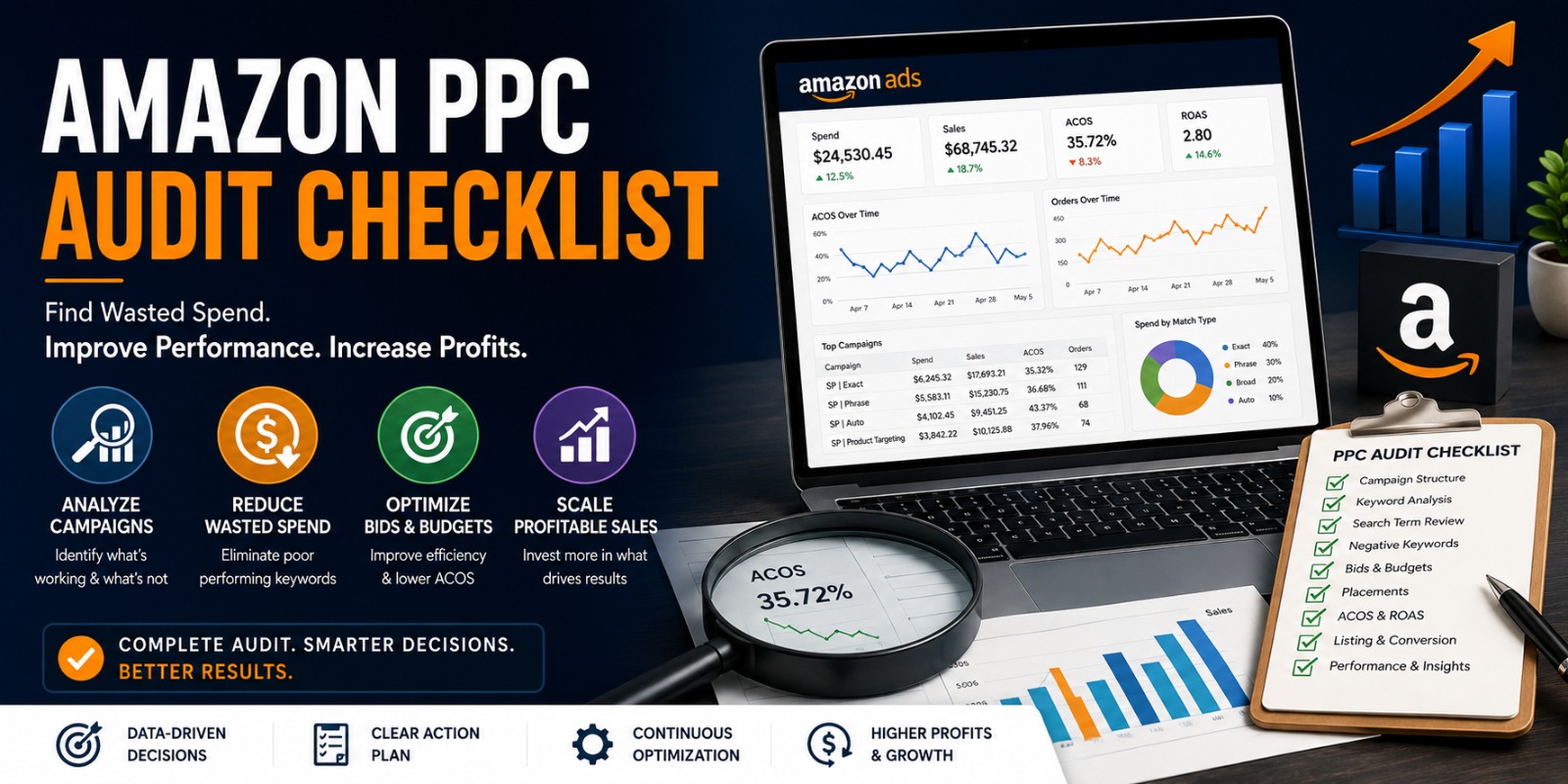
A complete amazon ppc audit checklist should cover campaign structure, keywords, search terms, negative targeting, bids, budgets, placements, ACOS, ROAS, conversion rates, product listings, and overall profitability.
For most sellers, a PPC audit should be performed at least monthly. High-spend or rapidly scaling accounts should be reviewed more frequently.
The goal is not simply to reduce advertising spend. The goal is to make every advertising dollar work harder.
Introduction
Amazon PPC can generate sales quickly, but it can also consume your budget just as quickly when campaigns are not managed properly.
This is particularly common with growing brands.
A seller launches campaigns, sees sales coming in, increases the budget, and assumes everything is working. A few months later, advertising spend has increased significantly, but profit has not increased at the same rate.
That is usually a sign that the account needs a proper review.
An Amazon PPC account should never be treated as a “set it and forget it” channel. Search behavior changes. Competitors adjust their bids. CPCs fluctuate. New keywords emerge. Products gain or lose conversion momentum.
A regular PPC audit helps you understand what is working, what is wasting money, and where your next growth opportunity lies.
This guide provides a practical framework for auditing Amazon PPC campaigns, whether you manage your account internally, work with a freelancer, or are considering professional Amazon Online Marketing Services.
What Is an Amazon PPC Audit?
An amazon ppc account audit is a detailed assessment of your advertising campaigns and their performance.
It goes beyond looking at ACOS.
A comprehensive audit examines:
- Campaign structure
- Keyword targeting
- Search terms
- Match types
- Negative keywords
- Bids
- Budgets
- Ad placements
- Conversion rates
- ACOS
- ROAS
- TACOS
- Product listing quality
- Campaign profitability
The objective is to identify problems and opportunities that aren’t immediately obvious from the Amazon Advertising dashboard.
The Basic Audit Framework
CAMPAIGN DATA
↓
STRUCTURE REVIEW
↓
KEYWORD ANALYSIS
↓
SEARCH TERM ANALYSIS
↓
BID & BUDGET REVIEW
↓
PLACEMENT ANALYSIS
↓
CONVERSION REVIEW
↓
OPTIMIZATION PLAN
↓
SCALE PROFITABLE CAMPAIGNS
Why Should You Audit Amazon PPC Campaigns?
A campaign can generate sales and still be inefficient.
For example:
| Metric | Current Performance |
|---|---|
| Ad Spend | $5,000 |
| Ad Sales | $12,500 |
| ACOS | 40% |
| Orders | 500 |
| Average CPC | $1.25 |
At first glance, the campaign appears successful.
But deeper analysis might reveal that 30% of the budget is being spent on search terms that have generated clicks but no sales.
That is where an audit becomes valuable.
The problem isn’t necessarily that the brand needs more traffic.
It may simply need better traffic.
When Should You Conduct an Amazon PPC Audit?
There isn’t one universal schedule, but this framework works well:
| Account Size | Recommended Audit |
| Small account | Monthly |
| Growing account | Every 2 to 4 weeks |
| High-spend account | Weekly |
| Enterprise account | Continuous monitoring |
You should also conduct an audit when:
- ACOS suddenly increases
- Sales decline
- CPC rises significantly
- Campaigns stop converting
- Advertising spend increases faster than revenue
- A new product is launched
- You enter a new marketplace
- You restructure your listings
- You begin working with a new PPC manager
Complete Amazon PPC Audit Checklist
1. Campaign Structure Audit
The first step in an amazon campaign audit is reviewing how your account is organized.
A well-structured account makes it easier to control budgets, analyze performance, and scale winning campaigns.
Check whether you have appropriate separation between:
- Auto campaigns
- Manual campaigns
- Branded keywords
- Non-branded keywords
- Competitor targeting
- Product targeting
- Individual products
- Product categories
Campaign Structure Checklist
- Campaign names are consistent
- Products are correctly grouped
- Auto and Manual campaigns are separated
- Brand and non-brand campaigns are separated where appropriate
- Competitor campaigns are identifiable
- Budgets align with campaign objectives
- Duplicate targeting is controlled
2. Keyword Audit
Keywords determine who sees your ads.
During your amazon ppc audit checklist, identify which keywords are:
Winners
Keywords generating profitable sales.
Action: Consider increasing bids or budgets.
Potential Winners
Keywords generating clicks and conversions but requiring more data.
Action: Monitor and optimize.
Expensive Keywords
Keywords receiving significant spend without enough sales.
Action: Review bids, relevance, and conversion.
Irrelevant Keywords
Keywords attracting shoppers who are unlikely to purchase.
Action: Consider negative targeting.
3. Search Term Audit
One of the most valuable parts of an amazon ads audit is analyzing actual customer search terms.
Your targeted keyword isn’t necessarily the exact phrase customers use.
For example, you might target:
running shoes
But Amazon could generate traffic from searches such as:
- men’s running shoes
- running shoes for women
- lightweight running shoes
- running shoes for gym
- cheap running shoes
Some may convert.
Others may waste budget.
Search Term Checklist
- Identify search terms generating sales
- Identify high-spend, no-sale terms
- Discover new keyword opportunities
- Add relevant converting terms to targeted campaigns
- Add irrelevant terms as negatives
- Review search-term trends regularly
4. Negative Keyword Audit
Negative keywords are one of the most effective tools for controlling wasted spend.
Suppose you’re selling premium leather office chairs.
Your ads may receive clicks for:
- office chair repair
- office chair parts
- used office chair
- office chair replacement wheels
These searches may have little purchase value for your product.
Negative targeting can help prevent your ads from appearing for irrelevant searches.
Negative Keyword Checklist
- Review high-spend/no-sale searches
- Identify irrelevant queries
- Add appropriate negative keywords
- Review negative targeting regularly
- Avoid unnecessarily blocking relevant traffic
5. Bid Audit
Your bid determines how aggressively you compete for advertising placements.
However, higher bids don’t automatically produce better results.
During your amazon advertising audit, compare bids against:
- CPC
- CTR
- Conversion rate
- Orders
- ACOS
- ROAS
- Profitability
Consider this example:
| Keyword | CPC | Orders | ACOS |
| Keyword A | $2.10 | 15 | 22% |
| Keyword B | $3.20 | 3 | 71% |
| Keyword C | $1.30 | 19 | 18% |
Keyword C may be the strongest scaling opportunity despite having the lowest CPC.
The goal is profitable traffic, not simply cheap traffic.
6. Budget Audit
Budget allocation is another critical component of a PPC audit.
Ask:
Where is the money going?
Then ask:
Is that where the best results are coming from?
Your highest-performing campaigns should have enough budget to continue capturing demand.
At the same time, low-performing campaigns shouldn’t consume disproportionate amounts of your advertising budget.
Simple Budget Framework
PROVEN CAMPAIGNS
60%
↓
GROWTH / TESTING
25%
↓
EXPERIMENTAL
15%
This is a starting framework, not a fixed rule.
Your actual allocation should depend on your goals, margins, and campaign performance.
7. Placement Audit
Amazon advertising placements can perform very differently.
Review performance across:
- Top of Search
- Rest of Search
- Product Pages
Look at:
- Impressions
- Clicks
- CPC
- Orders
- Conversion rate
- ACOS
A keyword may perform exceptionally well at the top of search but poorly on product pages.
That insight can help you make more informed placement and bidding decisions.
8. ACOS and ROAS Audit
An amazon ppc performance audit should never ignore profitability metrics.
ACOS
ACOS = Ad Spend ÷ Ad Revenue × 100
ROAS
ROAS = Ad Revenue ÷ Ad Spend
For example:
If you spend $1,000 and generate $4,000 in advertising sales:
ACOS = 25%
ROAS = 4
But whether 25% ACOS is good depends on your margins.
A product with a 15% profit margin cannot sustainably operate at 25% ACOS unless there are strategic reasons to do so.
9. TACOS Review
ACOS only looks at advertising-attributed revenue.
TACOS compares advertising spend with total sales.
This makes it particularly useful when evaluating the relationship between PPC and organic growth.
For example:
| Month | ACOS | TACOS |
| January | 38% | 24% |
| February | 35% | 21% |
| March | 31% | 18% |
If ACOS remains relatively high but TACOS is declining, your advertising may be contributing to broader sales growth.
This is why looking at one metric rarely tells the full story.
10. Product Listing Audit
PPC performance doesn’t exist independently from your product listing.
If shoppers click your ad but don’t buy, the problem may be on the product page.
Review:
- Product title
- Main image
- Secondary images
- Bullet points
- Product description
- A+ Content
- Reviews
- Ratings
- Pricing
- Promotions
- Product variations
If your product page needs stronger visual content and enhanced product storytelling, Amazon Enhanced Brand Content (A+ Content) Services can help improve the shopping experience and support better conversion potential.
A high CPC combined with a poor conversion rate is a reason to investigate the listing before simply increasing bids.
11. Conversion Rate Audit
Your conversion rate tells you what happens after the click.
Consider:
100 clicks → 2 orders
versus:
100 clicks → 12 orders
Both campaigns generated the same amount of traffic.
But the second campaign is clearly doing more with that traffic.
When conversion is weak, investigate:
- Product-market fit
- Price
- Reviews
- Images
- Product benefits
- Competitor offers
- Shipping
- Promotions
- Listing content
12. Product Targeting Audit
Don’t restrict your amazon ppc optimization checklist to keyword targeting.
Product targeting can help you reach shoppers browsing related products.
Review:
- Competitor ASIN targeting
- Complementary product targeting
- Category targeting
- Price filters
- Rating filters
- Product relevance
The objective is to identify product pages where your offer has a genuine competitive advantage.
13. Campaign Performance Segmentation
Not every campaign should be treated equally.
A useful framework is:
| Category | Performance | Action |
| Scale | High sales + strong profitability | Increase investment |
| Optimize | Sales but inefficient | Improve targeting/bids |
| Test | Limited data | Continue gathering data |
| Reduce | High spend + weak returns | Reduce bids/budget |
| Pause | Consistently poor | Consider pausing |
This prevents you from making the common mistake of treating every campaign the same way.
Amazon PPC Health Check
A complete amazon ppc health check should answer five questions:
1. Are we reaching the right shoppers?
Check keyword relevance and search terms.
2. Are we paying the right price for traffic?
Check CPC and bids.
3. Are shoppers converting?
Check conversion rate.
4. Are we generating profitable sales?
Check ACOS, ROAS, margins, and TACOS.
5. Are we scaling efficiently?
Check budgets, campaign growth, and overall sales trends.
If you cannot confidently answer these five questions, your account likely needs deeper analysis.
30-Day Amazon PPC Optimization Framework
Once the audit is complete, don’t try to change everything at once.
Week 1: Clean
- Remove irrelevant targeting
- Add negative keywords
- Fix campaign structure
- Identify wasted spend
Week 2: Optimize
- Adjust bids
- Reallocate budgets
- Improve keyword targeting
- Review placements
Week 3: Improve Conversion
- Review product listings
- Improve images
- Strengthen product messaging
- Review pricing and promotions
- Review A+ Content and consider Amazon A+ Content Services if your product pages need stronger visual presentation
Week 4: Scale
- Increase investment in winning campaigns
- Expand profitable keywords
- Test new targeting
- Monitor profitability
AUDIT
↓
CLEAN
↓
OPTIMIZE
↓
CONVERT
↓
SCALE
Common Amazon PPC Audit Mistakes
Auditing Only ACOS
ACOS is important, but it doesn’t tell you everything.
Making Changes Too Quickly
One bad day doesn’t necessarily mean a campaign is broken.
Ignoring Product Pages
Poor conversion may be a listing issue rather than an advertising issue.
Pausing Campaigns Too Early
New campaigns need enough data to make informed decisions.
Increasing Budgets Without Strategy
More budget can amplify both good and bad performance.
Copying Competitors
Your competitors’ bids and strategies may not match your margins or business objectives.
Complete Amazon PPC Audit Checklist
Use this as your final audit sheet:
Account Structure
- Campaign naming reviewed
- Product segmentation reviewed
- Auto/Manual structure reviewed
- Brand/non-brand structure reviewed
Keywords
- High-performing keywords identified
- Poor-performing keywords identified
- Search terms analyzed
- Negative keywords updated
- New keyword opportunities identified
Bids & Budgets
- CPC reviewed
- Bids adjusted
- Budget allocation reviewed
- Budget-limited campaigns identified
- Placement adjustments reviewed
Performance
- CTR reviewed
- Conversion rate reviewed
- ACOS reviewed
- ROAS reviewed
- TACOS reviewed
- Profitability reviewed
Product Page
- Title optimized
- Images reviewed
- Bullet points reviewed
- A+ Content reviewed
- Reviews monitored
- Pricing reviewed
Growth
- Winning campaigns identified
- Scaling opportunities identified
- New targeting opportunities identified
- Testing plan created
- Next 30-day optimization plan created
Key Takeaways
- A professional amazon ppc audit looks at the entire advertising ecosystem, not just ACOS.
- A structured amazon ppc audit checklist helps identify wasted spend and missed opportunities.
- An amazon ppc account audit should cover campaigns, keywords, search terms, bids, budgets, placements, and listings.
- An amazon ads audit can reveal where advertising spend is generating little or no return.
- A complete amazon advertising audit should connect advertising performance with overall business profitability.
- Use an amazon ppc optimization checklist to systematically improve targeting, bids, budgets, and conversions.
- A regular amazon campaign audit can help prevent performance problems from becoming expensive.
- An amazon ppc performance audit should evaluate ACOS, ROAS, TACOS, CTR, conversion rate, and sales.
- A detailed amazon ppc review should result in a specific action plan, not simply a performance report.
- A recurring amazon ppc health check helps Amazon brands maintain efficient campaigns as competition and customer behavior change.
Frequently Asked Questions
What is an Amazon PPC audit?
An Amazon PPC audit is a detailed review of an Amazon advertising account to identify wasted spend, inefficient campaigns, poor targeting, bid issues, budget problems, and opportunities for growth.
How often should I audit my Amazon PPC account?
Smaller accounts can generally be audited monthly, while high-spend accounts should be reviewed more frequently. Campaign performance should still be monitored regularly between full audits.
What should an Amazon PPC audit include?
A comprehensive audit should include campaign structure, keywords, search terms, negative targeting, bids, budgets, placements, ACOS, ROAS, TACOS, conversion rate, and product listing quality.
Can a PPC audit reduce Amazon advertising costs?
Yes, an audit can identify wasted spend and inefficient targeting. However, the goal shouldn’t simply be to spend less. The goal is to improve the return generated from your advertising investment.
Why are my Amazon PPC campaigns getting clicks but no sales?
Possible causes include irrelevant traffic, weak product listings, uncompetitive pricing, insufficient reviews, poor product-market fit, or targeting shoppers with low purchase intent.
Should I audit Amazon PPC myself or hire an expert?
Basic audits can be performed internally. However, larger accounts, international marketplaces, complex catalogs, or consistently underperforming campaigns may benefit from an experienced Amazon PPC specialist who can analyze the account at a deeper level.
Conclusion
Amazon PPC performance rarely improves because of one isolated change.
The biggest improvements usually come from identifying several smaller problems and fixing them systematically.
A poorly structured campaign, expensive keywords, irrelevant search terms, weak bids, inefficient budgets, and a low-converting listing can collectively turn a potentially profitable advertising account into an expensive source of traffic.
A structured amazon ppc audit gives you the visibility to see what is actually happening.
The process should be simple:
Audit the data. Identify the waste. Fix the structure. Improve conversion. Scale what works.
For brands selling across the US, UK, Canada, Australia, UAE, Europe, and other international marketplaces, regular PPC audits become even more important because competition, CPCs, customer behavior, and profitability can differ significantly by marketplace.
For brands looking to build a stronger long-term presence on Amazon, Amazon Brand Registry Services can complement PPC efforts by supporting brand visibility and helping establish a stronger presence on the marketplace.
The best Amazon advertising strategy isn’t necessarily the one with the biggest budget.
It’s the one that knows where to spend, where to reduce, what to test, and what to scale.
If you need help turning your PPC audit findings into an actionable growth strategy, professional Amazon Marketing Services can help improve advertising performance, product visibility, and overall Amazon growth.
If your Amazon account is generating traffic but your ACOS is rising, campaigns are becoming difficult to manage, or you’re unsure where your advertising budget is going, a professional PPC audit can provide the clarity needed to build a more efficient and scalable advertising strategy.
Looking beyond PPC performance? Amazon Brand Registry Services can help support your broader Amazon brand growth strategy alongside ongoing advertising and optimization efforts.