
Quick Answer
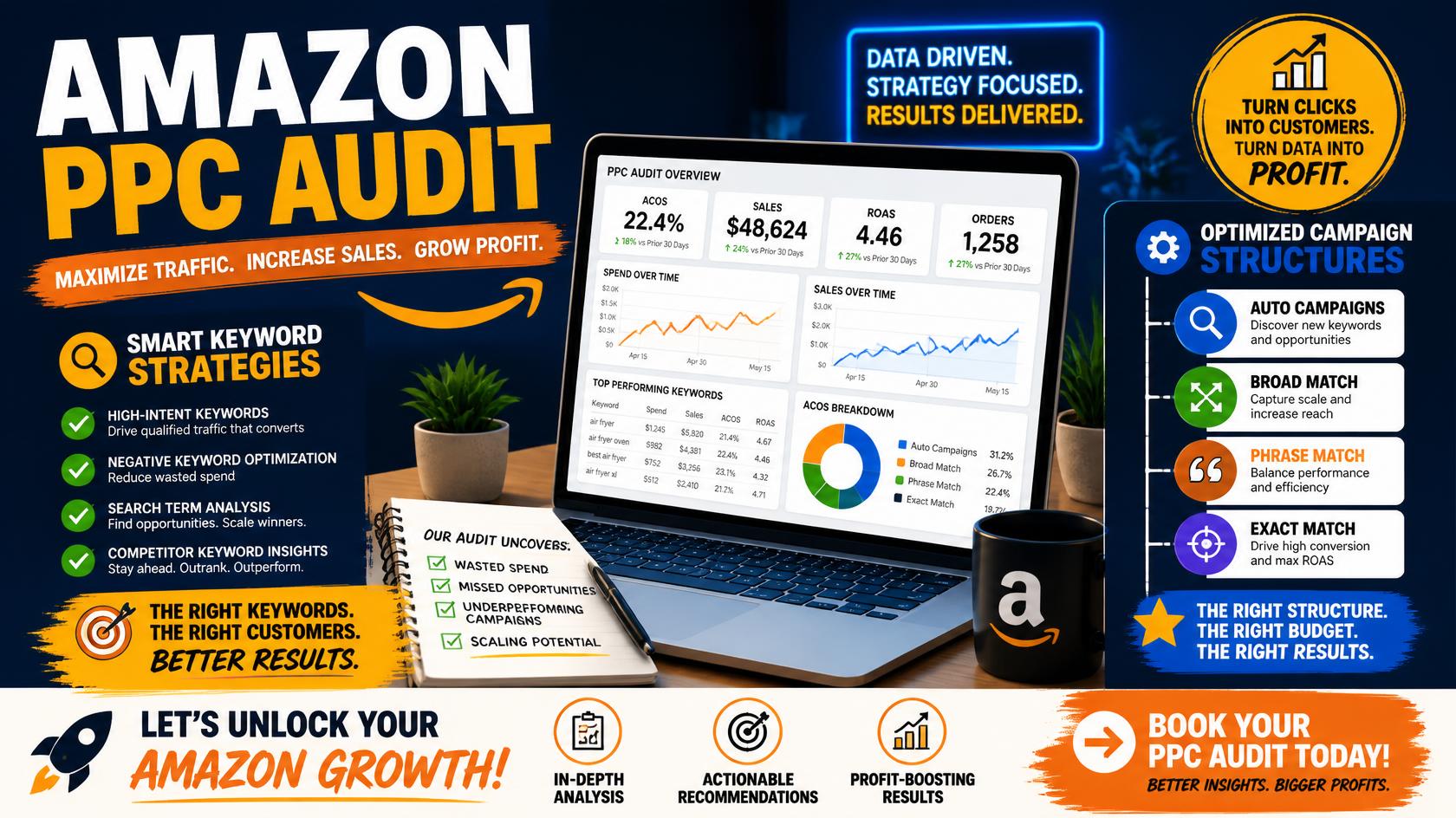
An amazon ppc audit is a structured review of your Amazon advertising account to identify wasted ad spend, improve keyword targeting, optimize bids, and increase profitability. A comprehensive audit examines campaign structure, search terms, budgets, placements, conversion rates, ACOS, ROAS, and listing performance to uncover opportunities for growth. Conducting a monthly audit helps sellers reduce wasted spend, improve campaign efficiency, and scale profitable products.
Why Every Amazon Seller Needs a PPC Audit
Many Amazon sellers believe launching campaigns is the difficult part.
It isn’t.
The real challenge begins after your campaigns go live.
Amazon’s advertising platform changes constantly. New competitors enter your niche, keyword costs fluctuate, customer behavior evolves, and Amazon introduces new advertising features every year. Campaigns that performed well three months ago may quietly become unprofitable today.
Unfortunately, many sellers only look at sales.
They rarely ask:
- Why is ACOS increasing?
- Which keywords are wasting money?
- Why are clicks increasing but conversions declining?
- Which campaigns deserve more budget?
- Are my listings helping or hurting PPC performance?
These questions are answered through a professional amazon ppc audit.
Rather than making random bid adjustments or increasing budgets, successful brands follow a structured auditing process that identifies exactly where performance can be improved.
Think of it like a regular health check-up.
Small issues detected early prevent much larger problems later.
What is an Amazon PPC Audit?
An amazon ppc account audit is a systematic evaluation of every aspect of your advertising account.
Instead of focusing on a single metric like ACOS, an audit reviews the complete advertising ecosystem.
This includes:
- Campaign organization
- Keyword performance
- Search terms
- Bid strategy
- Budget allocation
- Conversion rates
- Product listings
- Placements
- Advertising profitability
The objective isn’t simply lowering advertising costs.
The objective is maximizing profitable growth.
Why Regular Audits Matter in 2026
Amazon advertising has become increasingly competitive.
Several factors contribute to this:
- Higher CPCs
- More advertisers
- AI-powered bidding
- Increased competition from global brands
- Greater customer expectations
Without regular optimization, advertising costs naturally increase over time.
Brands performing monthly amazon ads audit reviews consistently outperform businesses that “set and forget” their campaigns.
Benefits of Conducting an Amazon PPC Audit
| Benefit | Business Impact |
| Reduced wasted spend | Higher profitability |
| Better keyword targeting | More qualified traffic |
| Improved conversion rate | Higher sales |
| Lower ACOS | Better ROI |
| Increased campaign efficiency | Faster scaling |
| Better budget allocation | Sustainable growth |
An audit isn’t about finding mistakes.
It’s about finding opportunities.
How Often Should You Audit Your Amazon Campaigns?
The answer depends on advertising spend.
| Monthly Ad Spend | Recommended Audit Frequency |
| Under $1,000 | Every 30 days |
| $1,000–$5,000 | Every 2 weeks |
| $5,000–$20,000 | Weekly |
| $20,000+ | Continuous monitoring |
Larger accounts generate more data, requiring more frequent analysis.
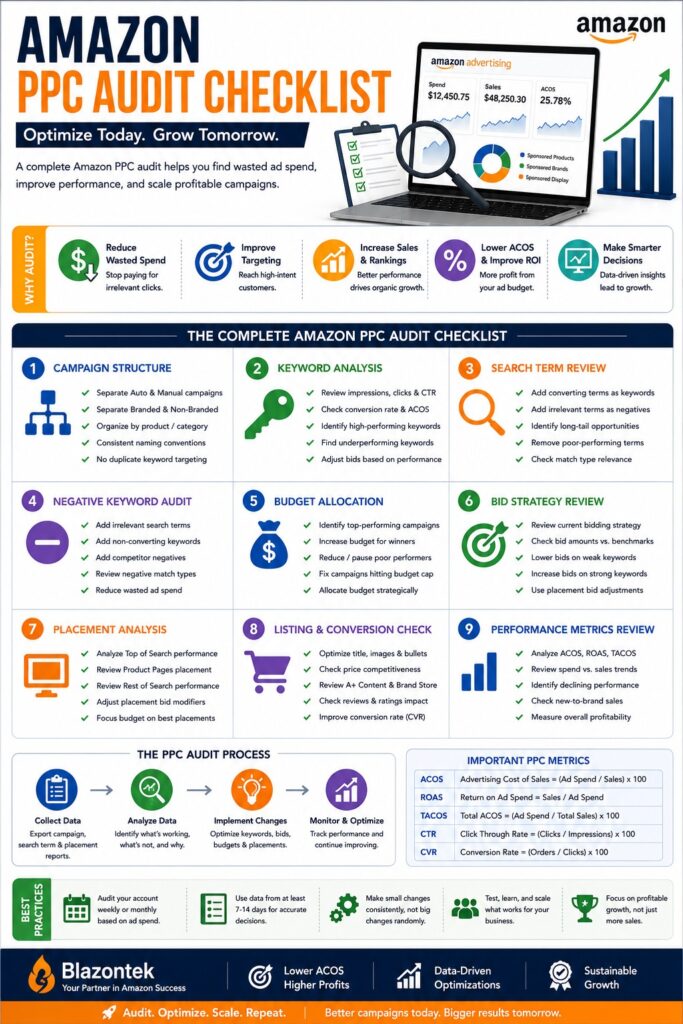
The Amazon PPC Audit Framework
Every successful amazon advertising audit follows a structured process.
Campaign Structure
↓
Keyword Analysis
↓
Search Term Review
↓
Bid Optimization
↓
Budget Review
↓
Placement Analysis
↓
Conversion Optimization
↓
Performance Scaling
Skipping any stage often leaves valuable opportunities undiscovered.
Step 1: Review Campaign Structure
Campaign organization directly affects optimization.
Poor campaign structure creates confusing reports and makes performance analysis difficult.
Ask yourself:
- Are campaigns organized by product?
- Are branded and non-branded keywords separated?
- Are Auto and Manual campaigns isolated?
- Are campaign names consistent?
- Are seasonal campaigns separate?
Example of an organized structure:
Sponsored Products
│
├── Auto Campaign
│
├── Manual Broad
│
├── Manual Phrase
│
├── Manual Exact
│
└── Product Targeting
Clean campaign architecture allows easier optimization.
Campaign Structure Checklist
✔ Separate Auto and Manual campaigns
✔ Separate branded keywords
✔ Separate competitor campaigns
✔ Separate product targeting campaigns
✔ Consistent campaign naming
✔ No duplicate keyword targeting
Step 2: Analyze Campaign Objectives
Not every campaign should have the same goal.
Campaigns generally fall into one of four categories.
| Campaign Goal | Primary KPI |
| Product Launch | Visibility |
| Growth | Sales |
| Profitability | ACOS |
| Brand Awareness | Reach |
Trying to optimize every campaign for the same metric often limits performance.
Step 3: Keyword Performance Analysis
Keywords are the foundation of every Amazon campaign.
Review each keyword individually.
Questions to ask:
- Is this keyword generating sales?
- Is CPC too high?
- Does CTR indicate relevance?
- Is conversion rate acceptable?
- Should the bid increase or decrease?
A professional amazon campaign audit always begins with keyword analysis before making bid changes.
Keyword Performance Table
| Metric | Healthy Range |
| CTR | Above 0.5% |
| Conversion Rate | Above 10% |
| ACOS | Depends on margins |
| Impressions | Growing steadily |
| Orders | Increasing consistently |
Never optimize using only one metric.
Every metric tells part of the story.
Step 4: Search Term Analysis
Keywords and search terms are not the same.
Keywords are what you target.
Search terms are what customers actually type.
Review Search Term Reports every week.
Look for:
- New converting keywords
- High-spend non-converting searches
- Irrelevant searches
- Long-tail opportunities
Search term reports often reveal opportunities your original keyword research missed.
Search Term Audit Checklist
✔ Add converting search terms to Manual campaigns
✔ Add irrelevant searches as negatives
✔ Remove poor-performing terms
✔ Identify seasonal keywords
✔ Discover long-tail phrases
Step 5: Negative Keyword Audit
Negative keywords protect your advertising budget.
Without them, Amazon may display your ads for irrelevant searches.
Example:
Selling premium ergonomic office chairs?
Negative keywords might include:
- Used
- Repair
- Replacement wheels
- Covers
- Parts
Removing poor-quality traffic immediately improves campaign efficiency.
This is one of the easiest wins during an amazon ppc optimization checklist.
Step 6: Budget Review
Many campaigns fail simply because budgets aren’t allocated correctly.
Ask:
- Which campaigns run out of budget?
- Which campaigns barely spend anything?
- Which campaigns generate the highest sales?
Budget should follow performance.
Not assumptions.
Budget Allocation Framework
Top Performing Campaigns
60%
Growing Campaigns
30%
Testing Campaigns
10%
This framework ensures profitable campaigns continue receiving sufficient investment.
Step 7: Bid Strategy Review
Amazon provides multiple bidding strategies.
Review whether your campaigns use:
- Dynamic Bids – Down Only
- Dynamic Bids – Up & Down
- Fixed Bids
Each strategy serves different business goals.
For established products, conservative bidding often improves profitability.
For launches, aggressive bidding may increase visibility.
Step 8: Placement Analysis
Amazon offers three primary placements.
| Placement | Best Use |
| Top of Search | Highest-converting keywords |
| Product Pages | Competitor targeting |
| Rest of Search | Budget discovery |
Review placement reports regularly.
Sometimes increasing placement adjustments delivers better results than increasing keyword bids.
Step 9: Evaluate Product Listings
One of the biggest PPC mistakes isn’t related to advertising at all.
It’s poor product pages.
Imagine spending $2 per click only to send customers to a listing with:
- Weak images
- Poor titles
- Generic bullet points
- Few reviews
- Missing A+ Content
Advertising can drive traffic.
Only strong listings convert visitors into buyers.
During every amazon ppc performance audit, evaluate listing quality alongside campaign metrics.
Amazon PPC Audit Checklist (Part 1)
| Audit Area | Status |
| Campaign Structure Reviewed | □ |
| Objectives Defined | □ |
| Keyword Performance Checked | □ |
| Search Terms Reviewed | □ |
| Negative Keywords Updated | □ |
| Budget Allocation Optimized | □ |
| Bid Strategy Reviewed | □ |
| Placement Reports Analyzed | □ |
| Product Listings Evaluated | □ |
Summary
An effective amazon ppc review starts with understanding your campaign foundation rather than making random bid adjustments. By reviewing campaign structure, keyword performance, search terms, negative keywords, budgets, placements, and product listings, you establish a clear picture of your account’s strengths and weaknesses.