
Quick Answer
The most effective amazon ppc strategy 2026 combines precise keyword targeting, AI-driven bid optimization, campaign segmentation, retail-ready product listings, and continuous performance analysis. Sellers who integrate PPC with SEO, A+ Content, and conversion optimization achieve lower ACOS, higher ROAS, and sustainable long-term growth.
Introduction
Amazon has evolved into one of the world’s most competitive advertising platforms. Millions of sellers compete for the same customers, and simply launching Sponsored Products campaigns is no longer enough.
In 2026, successful advertising is driven by strategy rather than budget. Brands that understand customer intent, optimize campaigns continuously, and improve their product pages consistently outperform competitors.
If you’ve noticed rising CPCs, increasing competition, or declining profitability, you’re not alone. The good news is that Amazon continues to reward advertisers who focus on relevance, conversion, and customer experience.
This guide explains the latest amazon ppc strategy, practical frameworks, and proven optimization methods that help brands generate more profitable sales in global Amazon marketplaces.
Why Amazon PPC Matters More Than Ever
Organic rankings remain important, but PPC has become the fastest way to:
- Launch new products
- Increase visibility
- Generate sales velocity
- Improve keyword rankings
- Collect valuable customer data
Today’s successful sellers don’t choose between SEO and PPC. They combine both.
Understanding the Amazon PPC Ecosystem
Amazon currently offers several advertising formats.
| Campaign Type | Best For |
| Sponsored Products | Product visibility |
| Sponsored Brands | Brand awareness |
| Sponsored Display | Retargeting |
| Sponsored Video | Higher engagement |
| Amazon DSP | Advanced audience targeting |
A complete amazon advertising strategy uses multiple campaign types depending on business objectives.
Amazon PPC Framework for 2026
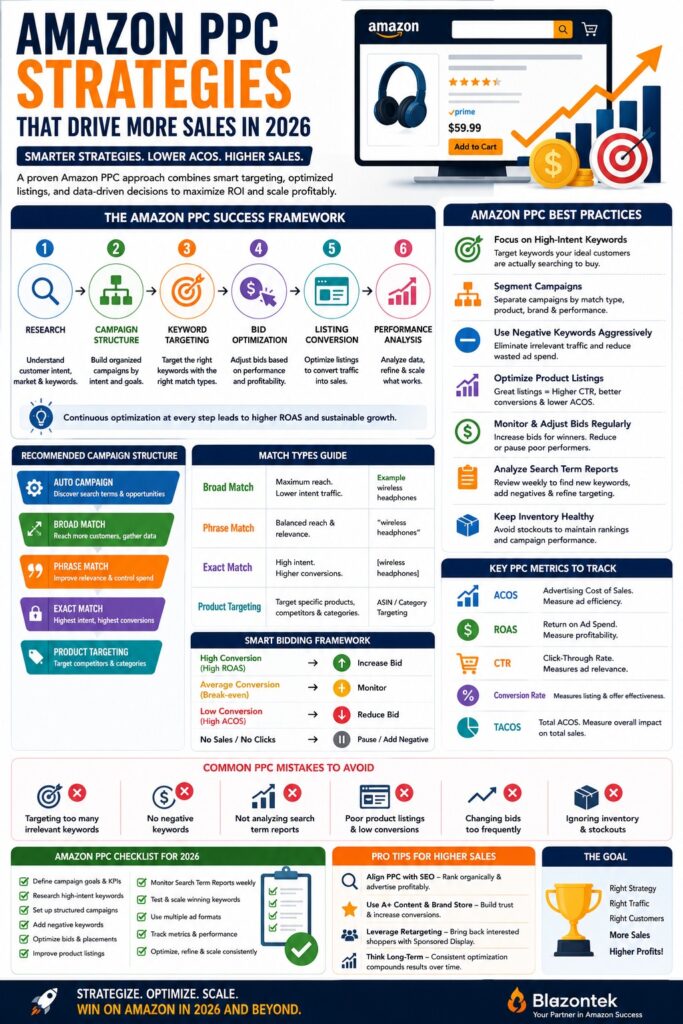
The most effective campaigns follow a structured process.
Research
↓
Campaign Structure
↓
Keyword Targeting
↓
Bid Optimization
↓
Listing Conversion
↓
Performance Analysis
↓
Scaling
Every stage supports the next.
Step 1: Start with Customer Intent
Many advertisers begin with keywords.
Winning advertisers begin with customers.
Ask:
- What problems are customers solving?
- Which keywords show buying intent?
- Which searches indicate comparison shopping?
- What objections prevent purchases?
Understanding intent creates better targeting.
Step 2: Build a Smart Campaign Structure
Avoid placing every keyword into one campaign.
Instead, organize campaigns by intent.
Recommended Structure
Auto Campaign
↓
Broad Match
↓
Phrase Match
↓
Exact Match
↓
Product Targeting
This structure allows continuous keyword discovery while protecting profitability.
A well-organized amazon ppc campaign strategy provides cleaner data and better optimization opportunities.
Step 3: Master Keyword Research
Keyword selection determines campaign quality.
Focus on three categories.
| Keyword Type | Purpose |
| High-volume keywords | Visibility |
| Long-tail keywords | Better conversion |
| Competitor keywords | Market share |
Avoid targeting every keyword available.
Prioritize relevance over volume.
Keyword Selection Checklist
✓ Commercial intent keywords
✓ Product-specific keywords
✓ Long-tail buying phrases
✓ Seasonal search terms
✓ Brand defense keywords
Step 4: Segment Campaigns Properly
Campaign segmentation is one of the biggest differences between average and professional advertisers.
Example
Instead of:
Campaign A
• 100 keywords
Use:
Campaign 1
Top sellers
Campaign 2
New launches
Campaign 3
Competitor targeting
Campaign 4
Branded keywords
Campaign 5
Seasonal products
This makes optimization significantly easier.
Step 5: Optimize Product Listings Before Scaling Ads
A poor listing wastes advertising budget.
Before increasing spend, optimize:
| Listing Element | Impact |
| Product title | High |
| Main image | Very High |
| Bullet points | High |
| A+ Content | High |
| Reviews | Very High |
| Pricing | High |
Advertising brings traffic.
Listings generate sales.
Step 6: Build a Winning Bid Strategy
Bid management has changed significantly.
Instead of increasing every bid:
Increase bids for:
- High-converting keywords
- Top-performing placements
- High-margin products
Reduce bids for:
- Expensive non-converting keywords
- Low CTR terms
- Poor placement performance
A successful amazon ppc optimization strategy is driven by profitability, not impressions.
Amazon Bid Optimization Framework
High Conversion
↓
Increase Bid
Average Conversion
↓
Monitor
Poor Conversion
↓
Reduce Bid
No Sales
↓
Pause or Add Negative
Step 7: Use Negative Keywords Aggressively
One of the fastest ways to improve performance is eliminating wasted spend.
Examples:
If selling premium coffee machines:
Negative keywords might include:
- Cheap
- Used
- Replacement parts
- Manual
Removing irrelevant traffic lowers ACOS immediately.
This remains one of the best amazon advertising tips for improving efficiency.
Step 8: Monitor Search Term Reports Weekly
Search Term Reports reveal:
- Winning keywords
- Wasted clicks
- New opportunities
- Negative keyword candidates
Weekly optimization keeps campaigns healthy.
Ignoring reports often results in unnecessary spending.
Step 9: Understand Amazon Placements
Amazon provides three primary placements.
| Placement | Typical Performance |
| Top of Search | Highest conversion |
| Product Pages | Good for competitor targeting |
| Rest of Search | Lower CPC |
Many successful brands increase placement adjustments only after identifying profitable keywords.
Step 10: Balance ACOS and ROAS
Many advertisers obsess over ACOS.
Successful brands evaluate:
- ACOS
- ROAS
- TACOS
- Profit margins
- Customer Lifetime Value
Sometimes a higher ACOS generates significantly more long-term profit.
PPC Metrics That Matter
| Metric | Why It Matters |
| CTR | Measures ad relevance |
| CPC | Cost efficiency |
| Conversion Rate | Listing quality |
| ACOS | Advertising efficiency |
| ROAS | Return on spend |
| TACOS | Overall business growth |
Never evaluate campaigns using only one metric.
Amazon PPC Best Practices for 2026
The following amazon ppc best practices consistently produce better results.
Prioritize High-Converting Keywords
Quality beats quantity.
Separate Branded Campaigns
Protect brand traffic.
Test Creatives
Sponsored Brands benefit from strong headlines.
Improve Listings Regularly
Higher conversions reduce advertising costs.
Monitor Inventory
Running out of stock damages campaign momentum.
Scale Gradually
Increase budgets based on performance, not assumptions.
Common Amazon PPC Mistakes
| Mistake | Result |
| Broad targeting only | Wasted budget |
| No negative keywords | Poor ROI |
| Weak listings | Low conversion |
| Ignoring reports | Missed opportunities |
| Daily bid changes | Unstable campaigns |
Avoiding mistakes often produces bigger gains than launching new campaigns.
PPC Optimization Framework
Research
↓
Launch
↓
Analyze
↓
Optimize
↓
Scale
↓
Repeat
Continuous improvement is the foundation of how to optimize amazon ppc effectively.
Real World Example
A consumer electronics brand struggled with:
- ACOS above 42%
- Low conversion rate
- High CPC
After restructuring campaigns:
- Exact Match campaigns isolated
- Negative keywords expanded
- Product pages redesigned
- Bid adjustments refined
- Sponsored Brands introduced
Results after 60 days:
| Metric | Before | After |
| ACOS | 42% | 24% |
| CTR | 0.58% | 1.14% |
| Conversion Rate | 9% | 18% |
| Sales | + | 63% increase |
The improvements came from strategy, not increased advertising spend.
Future Trends in Amazon PPC
The future of Amazon advertising will focus on:
- AI-assisted bidding
- Predictive analytics
- First-party customer data
- Video advertising
- Audience segmentation
- Retail readiness
- Omnichannel attribution
Advertisers who adapt early will gain significant competitive advantages.
Amazon PPC Checklist for 2026
Campaign Setup
✓ Organized campaign structure
✓ Relevant keyword research
✓ Negative keyword list
✓ Placement optimization
Listing Optimization
✓ SEO title
✓ High-quality images
✓ Strong bullet points
✓ A+ Content
✓ Competitive pricing
Weekly Optimization
✓ Search Term Report
✓ Bid adjustments
✓ Budget allocation
✓ Keyword expansion
✓ Placement analysis
Key Takeaways
- A successful amazon ppc strategy starts with understanding customer intent.
- The best amazon ppc strategy 2026 combines campaign structure, keyword optimization, and conversion-focused listings.
- A complete amazon advertising strategy includes Sponsored Products, Sponsored Brands, Sponsored Display, and video campaigns where appropriate.
- Strong amazon ads strategy depends on continuous optimization rather than one-time setup.
- Every amazon ppc campaign strategy should include negative keywords, bid adjustments, and regular Search Term Report analysis.
- Following amazon ppc best practices helps reduce wasted spend while improving profitability.
- Applying practical amazon advertising tips consistently delivers better long-term results.
- Learning how to optimize amazon ppc requires ongoing testing, performance analysis, and refinement.
- A successful amazon ppc optimization strategy integrates PPC with SEO and listing improvements.
- This comprehensive amazon ppc guide is designed to help sellers build scalable campaigns that generate sustainable growth.
Frequently Asked Questions
What is the best Amazon PPC strategy for 2026?
The best strategy combines campaign segmentation, high-intent keywords, optimized listings, smart bidding, and continuous performance analysis.
How often should Amazon PPC campaigns be optimized?
Campaigns should be reviewed weekly, with major strategic evaluations every month.
Should beginners use Auto campaigns?
Yes. Auto campaigns help discover profitable search terms that can later be moved into Manual campaigns.
What is a healthy ACOS?
The ideal ACOS depends on product margins, but many profitable brands target between 20% and 30%.
Does PPC improve Amazon SEO?
Yes. Increased sales velocity and keyword relevance from PPC often contribute to improved organic rankings.
Conclusion
Amazon PPC in 2026 is no longer about simply increasing bids or spending more on ads. The brands achieving consistent growth are those that treat advertising as a strategic investment rather than an expense.
A winning approach starts with understanding customer intent, building a structured campaign architecture, selecting the right keywords, and continuously optimizing based on real performance data. Combined with high-converting product listings and a strong brand presence, PPC becomes a powerful engine for long-term growth.
Whether you’re launching a new product or scaling an established catalog, the strategies outlined in this guide will help you reduce wasted spend, improve profitability, and stay ahead in an increasingly competitive marketplace. The key is not to chase every click, but to attract the right customers, convert them efficiently, and build a scalable advertising system that delivers results year after year.