
If you sell on Amazon, there’s one thing that quietly controls your entire business — whether you realize it or not. It’s not your product quality alone, and it’s not just your price. It’s an algorithm most sellers have heard of but very few truly understand: A9.
A9 is Amazon’s search and ranking algorithm — the system that decides which products show up first, second, or fiftieth when a customer types something into that search bar. With over 12 million products competing for attention on Amazon, getting A9 to notice you isn’t optional. It’s the difference between a listing that generates consistent sales and one that sits invisible on page 9, no matter how good the product actually is.
This is exactly the gap that Blazontek’s Amazon Digital Marketing Services are built to close. In this guide, we’ll break down exactly how A9 works step by step, the key ranking factors it considers, and the practical actions you can take today to improve your visibility and sales.
What Is Amazon’s A9 Algorithm, Exactly?
Think of A9 as Amazon’s version of Google’s search algorithm, but with one crucial difference: while Google is optimized to give people the most informative answer, A9 is optimized to give people the most relevant purchase. Amazon isn’t a search engine in the traditional sense — it’s a shopping engine. Every decision A9 makes is ultimately in service of one goal: getting the customer to buy something they’ll be happy with, as quickly and easily as possible.
That’s an important mindset shift. Many sellers treat Amazon SEO like they would Google SEO — stuffing keywords everywhere and hoping for the best. But A9 cares just as much about buying signals as it does about keyword matching. A perfectly keyword-optimized listing with poor sales, low reviews, and no stock will still lose to a decent listing that’s actually converting.
With that context in mind, let’s walk through exactly how A9 processes a search from start to finish.
The 6-Step A9 Process: From Search to Sale
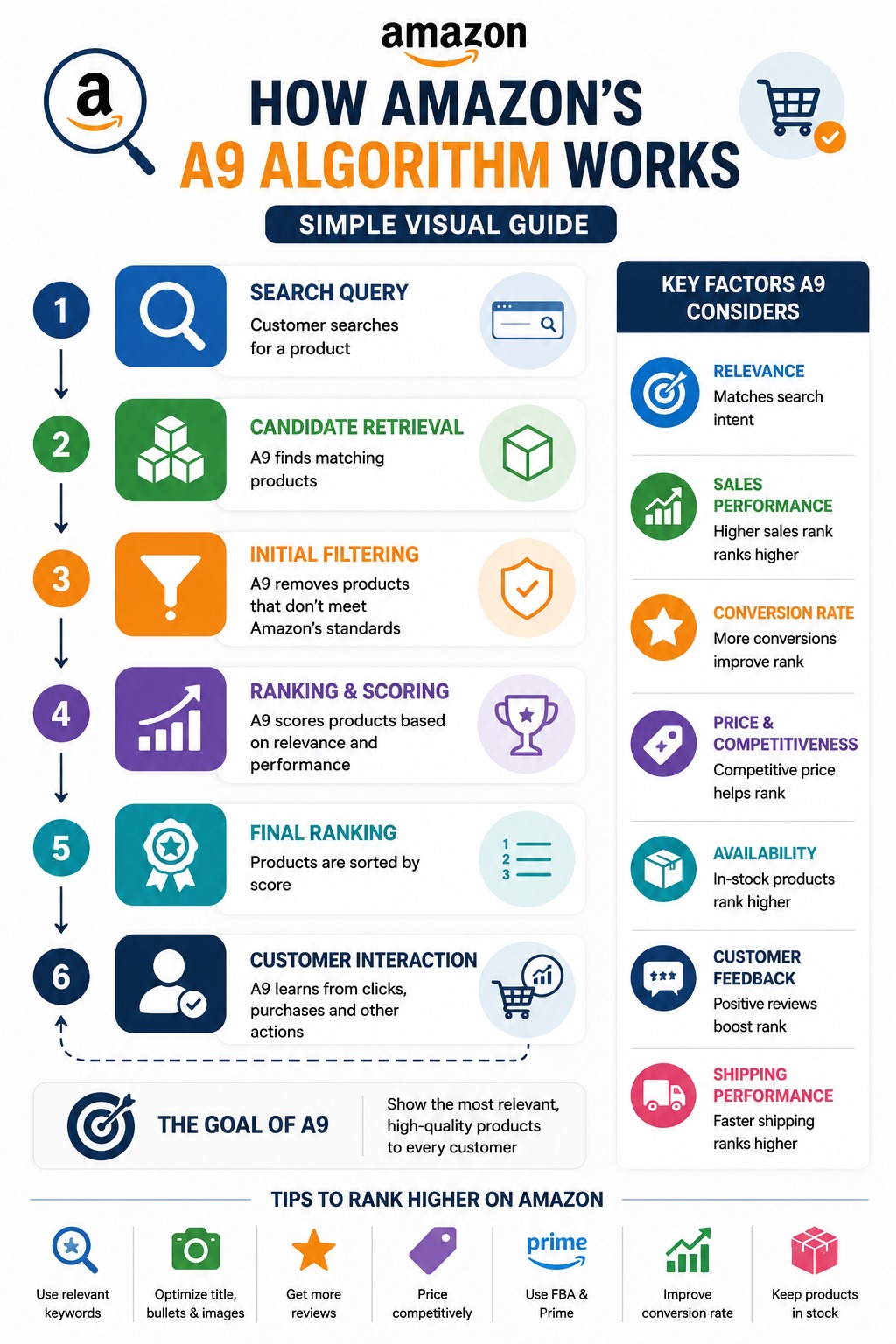
Step 1: Search Query
Everything begins the moment a customer types a search into the Amazon search bar — something like “wireless earbuds” or “stainless steel water bottle 1 litre.” This query is the input that kicks off the entire ranking process. A9 immediately starts working to interpret what the customer actually wants, not just the literal words they typed, factoring in search intent, past purchase behavior, and even seasonal trends.
Step 2: Candidate Retrieval
Once A9 understands the query, it needs to build a pool of potential matches. This step is essentially a broad sweep across Amazon’s entire catalog to pull together every product that could plausibly be relevant — based on title, backend keywords, category, and product attributes.
At this stage, A9 isn’t judging quality yet. It’s simply casting a wide net. This is exactly why keyword coverage matters so much — if your product isn’t retrieved as a candidate here, it has zero chance of appearing anywhere in the results, no matter how good it is.
Step 3: Initial Filtering
Not every candidate makes it to the next round. In this step, A9 filters out products that don’t meet Amazon’s minimum standards. This could include:
- Listings with missing or incomplete information
- Products that violate Amazon’s policies
- Suppressed or inactive listings
- Items with quality or compliance issues flagged by Amazon
This filtering step exists to protect the customer experience. Amazon doesn’t want to show shoppers a product that’s broken, mislabeled, or against platform policy — so a poorly maintained listing can get filtered out before it’s even considered for ranking.
Step 4: Ranking & Scoring
This is the heart of the A9 algorithm, and where most of the ranking magic happens. Every product that survives the filtering stage gets scored based on two broad categories:
- Relevance — how well the product matches the customer’s specific search intent
- Performance — how well the product actually sells, converts, and satisfies customers once it’s shown
A9 essentially blends these two signals together to generate a composite score for every product against every search query. A product might be highly relevant but perform poorly, or it might perform brilliantly but be only loosely relevant — A9 is constantly balancing both.
Step 5: Final Ranking
Once every candidate product has a score, A9 sorts them from highest to lowest, and this becomes the order customers see in the search results. The products at the top of page one aren’t there by luck — they’ve earned the highest combined relevance-and-performance score for that specific search term, at that specific moment.
Rankings aren’t static, either. The same product can rank differently for different keywords, and positions shift constantly based on new sales data, stock levels, and competitor activity.
Step 6: Customer Interaction (The Feedback Loop)
Here’s the part most sellers don’t think about: A9 doesn’t stop working once the results are displayed. It actively tracks what customers do next — what they click on, what they add to cart, what they purchase, and what they return or complain about.
This behavioral data feeds directly back into the algorithm, refining future rankings. If your listing gets clicked on frequently but rarely converts, that’s a signal to A9 that something’s off — maybe your images oversell the product, or your price feels high relative to what’s shown. On the other hand, a listing with a high click-to-purchase ratio tells A9 “customers who see this, want this,” reinforcing and improving its ranking over time.
The goal of A9, summarized: show the most relevant, high-quality products to every customer, every single time.
The 7 Key Factors A9 Considers When Ranking Products
Now that you understand the process, let’s dig into the specific factors A9 weighs most heavily. These are the levers you actually have some control over as a seller.
1. Relevance
This is the foundation. Relevance is about how closely your product listing — title, bullet points, description, backend search terms, and category — matches what customers are actually searching for. If you sell a “stainless steel insulated water bottle” but your listing only mentions “bottle” and “steel,” you’re leaving relevance points on the table. A9 needs to clearly understand what your product is and who it’s for.
2. Sales Performance
Products with a strong, consistent sales history and a higher sales rank within their category tend to rank higher in search. This creates a bit of a snowball effect: better rank leads to more visibility, which leads to more sales, which leads to even better rank. This is exactly why the early days of a new product launch are so critical.
3. Conversion Rate
Conversion rate — the percentage of people who view your listing and actually buy — is one of the strongest signals of listing quality that A9 tracks. A high conversion rate tells Amazon that your listing does a great job of matching customer expectations with what they’re actually getting. This is where high-quality visual storytelling makes a real difference — and it’s a big part of why Amazon Enhanced Brand Content (A+ Content) Services matter so much. Rich comparison charts, lifestyle imagery, and brand storytelling modules directly influence how confidently a shopper clicks “Buy Now.”
4. Price & Competitiveness
Amazon wants to show customers products that offer fair value. If your price is significantly higher than comparable products without a clear justification (like premium branding or added features), A9 may deprioritize your listing in favor of more competitively priced alternatives. This doesn’t mean you always need to be the cheapest — but you do need to be perceived as fair relative to your category.
5. Availability
An out-of-stock listing is essentially invisible to A9, and even intermittent stockouts can hurt your long-term ranking. Amazon’s entire business model depends on reliable fulfillment, so consistently available inventory is treated as a strong positive signal.
6. Customer Feedback
Reviews and ratings are one of the most visible trust signals on Amazon, and they matter just as much to the algorithm as they do to shoppers. Positive reviews boost your ranking, while a high volume of negative reviews or low ratings can actively suppress it.
7. Shipping Performance
Speed matters — a lot. Products that ship quickly, especially those fulfilled through FBA (Fulfilled by Amazon) or eligible for Prime, get a meaningful ranking advantage. Amazon has built its entire brand promise around fast, reliable delivery, so it makes sense that shipping speed is baked directly into how products get ranked.
7 Practical Tips to Rank Higher on Amazon
Understanding the algorithm is only half the battle — here’s how to actually apply it to your listings:
- Use relevant keywords everywhere it counts. Research the exact terms your customers are searching for and weave them naturally into your title, bullet points, description, and backend search terms.
- Optimize your title, bullets, and images. Your title should be clear and keyword-rich without being spammy. Bullet points should highlight benefits, not just features. And your images should be high-quality, show the product from multiple angles, and answer common customer questions visually.
- Invest in A+ Content. This is one of the highest-leverage improvements a brand can make. Enhanced Brand Content lets you replace plain-text descriptions with rich modules — comparison tables, brand story sections, and lifestyle imagery — that boost both conversion rate and time-on-listing, two metrics A9 directly rewards.
- Get more reviews. Reviews build both customer trust and algorithmic trust. Use Amazon’s “Request a Review” button, consider enrolling eligible products in the Vine program, and always deliver a product experience worth reviewing well.
- Price competitively. Regularly benchmark your pricing against similar products in your category. Small price adjustments can sometimes unlock meaningful ranking improvements, especially in competitive niches.
- Use FBA and Prime. If you’re not already using Fulfilled by Amazon, it’s worth strongly considering — the ranking boost from Prime eligibility and fast shipping can be significant, on top of the customer trust that comes with the Prime badge.
- Keep products in stock. Treat inventory planning as a ranking strategy, not just an operations task. Use Amazon’s inventory forecasting tools and build in buffer stock during high-demand periods to avoid costly stockouts.
Why Most Sellers Struggle With A9 (And How to Fix It)
Here’s the honest truth: understanding A9 in theory is very different from executing it well in practice. Keyword research, listing optimization, A+ Content design, PPC management, and review generation are all moving parts that need to work together consistently — not as one-time fixes, but as an ongoing strategy.
This is exactly where a dedicated partner makes the difference. Blazontek’s Amazon Digital Marketing Services are built specifically to help brands navigate every layer of the A9 algorithm — from listing optimization and keyword strategy to PPC campaign management and inventory-aligned marketing pushes. Instead of guessing what the algorithm wants, you get a data-driven strategy built around exactly what A9 rewards.
And when it comes to conversion rate — arguably the single biggest lever in the entire ranking equation — Blazontek’s Amazon Enhanced Brand Content (A+ Content) Services help brands turn ordinary listings into premium shopping experiences. Professionally designed A+ Content modules don’t just make your brand look more credible; they directly improve the conversion signals that A9 uses to rank you higher.
Bringing It All Together
A9 isn’t a mysterious black box designed to keep sellers guessing — once you understand it, it’s actually a fairly logical system built around one core principle: match customers with the most relevant, high-quality products, as efficiently as possible.
Every factor we’ve covered — relevance, sales performance, conversion rate, pricing, availability, reviews, and shipping — all ladders up to that same goal. When you optimize your listings with this principle in mind, you’re not gaming the algorithm. You’re simply making it easier for A9 to recognize your product as exactly what it’s designed to reward.
The sellers who consistently rank at the top aren’t the ones who found some secret loophole. They’re the ones who treat every element of their listing — keywords, images, pricing, stock, and customer experience — as part of one connected system.
Ready to turn A9 into your growth engine instead of your biggest obstacle?
Get in touch with Blazontek today for expert Amazon Digital Marketing Services and Amazon Enhanced Brand Content (A+ Content) Services, and let’s build a ranking strategy that actually converts.
👉 Contact Blazontek to get started.
