
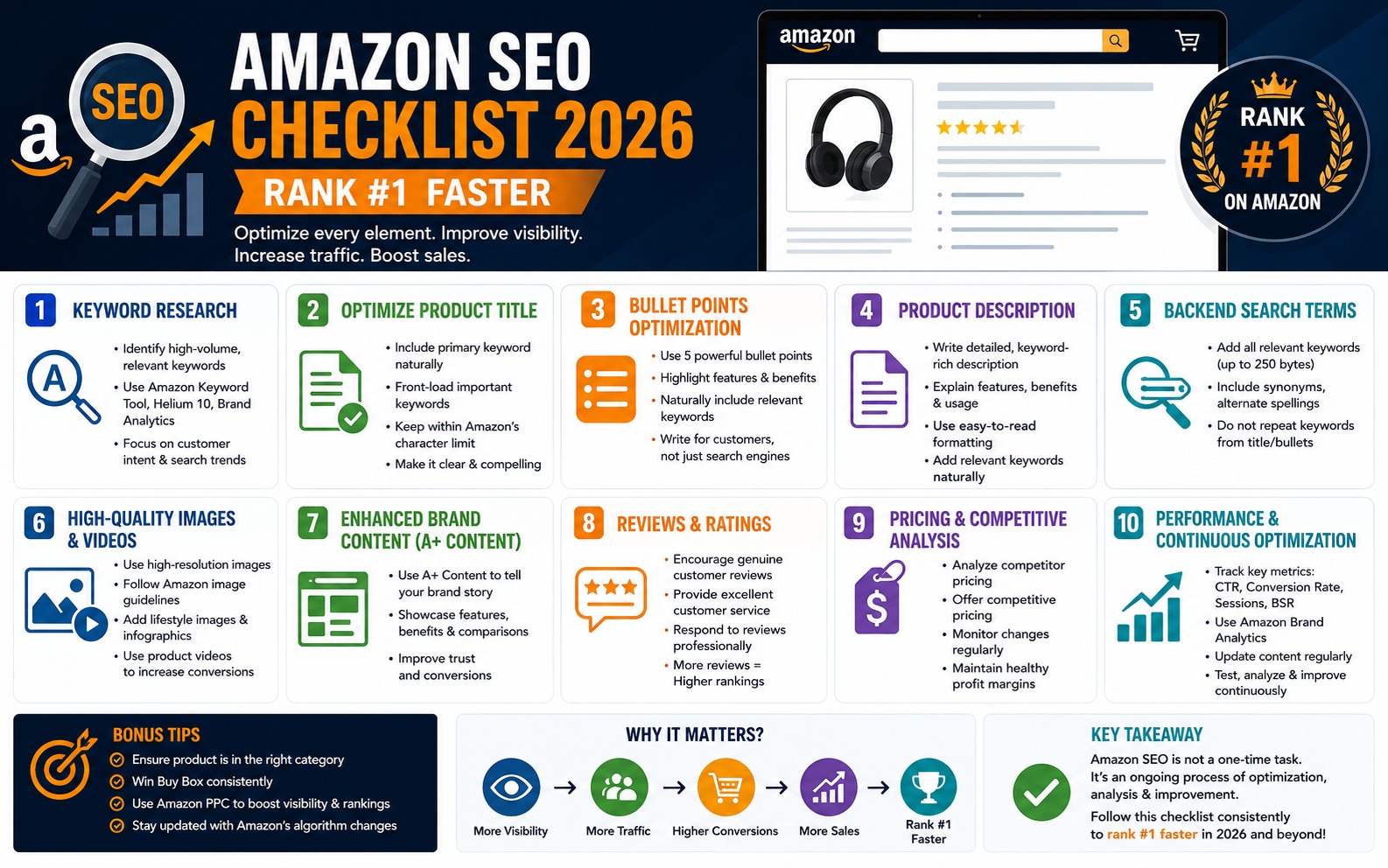
Quick Answer Snippet
The best way to rank higher on Amazon in 2026 is to combine keyword optimization, high-converting listings, strong click through rates, consistent sales velocity, and customer engagement. A complete Amazon SEO Checklist 2026 should include optimized titles, backend keywords, A+ Content, image improvements, PPC support, and conversion focused listing strategies.
Amazon has become more competitive than ever. Thousands of new sellers enter the marketplace every month, and simply uploading a product listing is no longer enough to generate sales.
In 2026, Amazon SEO is no longer just about keywords. The algorithm now prioritizes buyer behavior, conversion signals, customer experience, and listing quality. Sellers who understand this shift are the ones dominating rankings and building sustainable sales.
This guide covers a complete amazon seo optimization checklist designed to help brands improve visibility, rank faster, and convert more customers across international marketplaces.
Whether you are launching a new product or scaling an existing brand, this guide will help you understand how to rank products on Amazon using modern SEO strategies that actually work.
Why Amazon SEO Matters in 2026
Amazon’s algorithm is designed around one goal: maximizing revenue per search.
That means Amazon promotes listings that:
- Get more clicks
- Convert better
- Generate consistent sales
- Deliver strong customer experiences
If your listing performs well in these areas, your rankings improve naturally.
Amazon SEO Framework for 2026
A simplified SEO model looks like this:
Visibility → Clicks → Conversions → Sales Velocity → Higher Ranking
Every stage matters.
A product may rank initially because of keywords, but long term success depends on conversion performance.
Understanding Amazon Ranking Factors 2026
The latest amazon ranking factors 2026 focus heavily on buyer interaction signals.
Core Ranking Factors
| Ranking Factor | Importance |
| Keyword relevance | Very High |
| Conversion rate | Very High |
| Sales velocity | Very High |
| Click through rate | High |
| Product reviews | High |
| Pricing competitiveness | Medium |
| Inventory consistency | Medium |
The biggest change in recent years is that Amazon increasingly rewards listings that convert consistently instead of listings that simply contain keywords.
Step 1: Keyword Research Strategy
Keyword research is the foundation of every successful listing.
Without the right keywords, your products will struggle to appear in search results.
Types of Keywords to Target
| Keyword Type | Example |
| Primary keyword | wireless earbuds |
| Long tail keyword | noise cancelling wireless earbuds |
| Buyer intent keyword | best wireless earbuds for gym |
| Competitor keyword | alternative to AirPods |
A complete amazon listing seo guide always starts with understanding buyer intent.
Keyword Research Checklist
Include Keywords In:
- Product title
- Bullet points
- Backend search terms
- Product description
- A+ Content naturally
Avoid:
- Keyword stuffing
- Repeating the same keyword excessively
- Irrelevant traffic keywords
Smart optimization always beats aggressive keyword usage.
Step 2: Optimize Product Titles
Your title impacts both rankings and click through rates.
Product Title Framework
Brand + Main Keyword + Key Feature + Size/Quantity + Benefit
Example
Instead of:
“Bluetooth Earbuds”
Use:
“Blazontek Wireless Bluetooth Earbuds with Noise Cancellation and Fast Charging”
This improves discoverability while remaining customer friendly.
Step 3: Improve Click Through Rate
A high ranking listing with poor clicks will eventually lose visibility.
Amazon tracks:
- Click through rate
- Customer engagement
- Session performance
Elements That Improve CTR
| Element | Impact |
| Main image | Very High |
| Product title | High |
| Ratings | High |
| Pricing | Medium |
| Prime badge | Medium |
This is one of the most overlooked amazon seo tips for sellers.
Step 4: Bullet Point Optimization
Your bullet points should focus on benefits, not just features.
Weak Example
“Made with stainless steel”
Better Example
“Durable stainless steel construction designed for long lasting daily use”
Good bullet points:
- Improve conversion rates
- Reduce customer hesitation
- Increase sales velocity
Step 5: Backend Search Terms Optimization
Backend keywords help Amazon understand your listing better.
Backend SEO Checklist
| Action | Status |
| Add long tail keywords | ✓ |
| Include synonyms | ✓ |
| Avoid punctuation | ✓ |
| Avoid duplicate keywords | ✓ |
| Stay relevant | ✓ |
Backend optimization is a critical part of every amazon seo optimization checklist.
Step 6: Image Optimization Strategy
Images influence conversion more than almost any other element.
Essential Image Types
| Image Type | Purpose |
| Main image | Improve CTR |
| Lifestyle image | Build trust |
| Infographic | Explain benefits |
| Comparison image | Differentiate product |
| Dimensions image | Reduce confusion |
International buyers especially rely heavily on visuals before purchasing.
Step 7: A+ Content Optimization
A+ Content improves:
- Conversion rates
- Customer trust
- Brand authority
A+ Content Checklist
- Clear branding
- Mobile friendly design
- Product comparison charts
- Benefit focused visuals
- Simple layouts
Strong A+ Content supports long term amazon product ranking strategy performance.
Step 8: Review and Ratings Strategy
Reviews directly impact trust and conversions.
Review Optimization Tips
| Strategy | Impact |
| Deliver quality products | Higher ratings |
| Fast customer support | Better feedback |
| Request reviews ethically | More reviews |
| Improve packaging | Better experience |
Listings with higher ratings usually rank better because they convert better.
Step 9: Inventory and Fulfillment
Many sellers ignore inventory consistency.
Stockouts hurt:
- Sales velocity
- Organic rankings
- PPC efficiency
Fulfillment Best Practices
- Maintain healthy stock levels
- Use FBA where possible
- Monitor inventory forecasting
- Avoid sudden stock shortages
Step 10: PPC and SEO Together
One of the biggest mistakes sellers make is separating PPC from SEO.
The reality is:
PPC helps SEO by increasing:
- Sales velocity
- Keyword relevance
- Product visibility
SEO + PPC Framework
Optimized Listing + Strategic PPC = Faster Organic Ranking
This is essential for brands trying to understand how to rank products on Amazon faster.
Amazon SEO Checklist for 2026
Listing Optimization Checklist
Keywords
- Primary keyword included naturally
- Long tail keywords added
- Backend keywords optimized
Content
- Benefit driven bullet points
- SEO optimized title
- Strong product description
- A+ Content included
Visuals
- High quality images
- Lifestyle photography
- Infographics
Conversion
- Competitive pricing
- Positive reviews
- Fast shipping
- Mobile optimized listing
Common Amazon SEO Mistakes
| Mistake | Result |
| Keyword stuffing | Lower readability |
| Weak images | Poor CTR |
| Generic bullet points | Low conversion |
| Ignoring reviews | Weak trust |
| No backend optimization | Missed ranking opportunities |
Avoiding these mistakes is just as important as optimization itself.
Real World Example
A home improvement brand struggled with poor rankings despite running ads.
After implementing:
- Better keyword targeting
- Image redesign
- SEO optimized titles
- Improved bullet points
- Enhanced A+ Content
Results within 60 days:
- Organic traffic increased by 48%
- Conversion rate improved by 22%
- ACOS reduced significantly
- Multiple keywords reached Page 1 rankings
This demonstrates how strong SEO compounds over time.
Key Takeaways
- The Amazon SEO Checklist 2026 focuses heavily on conversion performance
- Keywords alone are no longer enough
- Click through rate and sales velocity matter more than ever
- Images and A+ Content directly impact rankings
- PPC supports organic SEO growth
- Backend keywords remain important
- Consistent optimization delivers long term growth
FAQs
1. What is the most important Amazon ranking factor in 2026?
Conversion rate and sales velocity are among the strongest ranking factors because Amazon prioritizes products that generate revenue consistently.
2. How long does Amazon SEO take to work?
Most listing improvements show measurable ranking impact within 2 to 8 weeks depending on competition and sales volume.
3. Does PPC improve Amazon SEO?
Yes. PPC improves visibility and sales velocity, which positively influences organic rankings.
4. How many keywords should I target?
Focus on a core group of highly relevant primary and secondary keywords instead of targeting hundreds of unrelated terms.
5. Is A+ Content important for SEO?
Indirectly, yes. A+ Content improves conversions and customer engagement, which supports better rankings.
Conclusion
Amazon SEO in 2026 is no longer about finding shortcuts. It is about building listings that genuinely perform better for customers.
The sellers winning today are not simply adding more keywords. They are creating optimized product experiences through strong visuals, better copywriting, strategic PPC support, and customer focused branding.
A successful Amazon SEO Checklist 2026 combines technical optimization with conversion strategy. When done correctly, rankings improve naturally because Amazon sees your listing as valuable to shoppers.
For brands targeting international markets, this becomes even more important. Overseas customers compare products quickly, evaluate trust instantly, and expect premium shopping experiences.
If your goal is to rank faster, reduce dependency on ads, and scale sustainably, now is the time to invest in a smarter SEO strategy built for the future of Amazon.